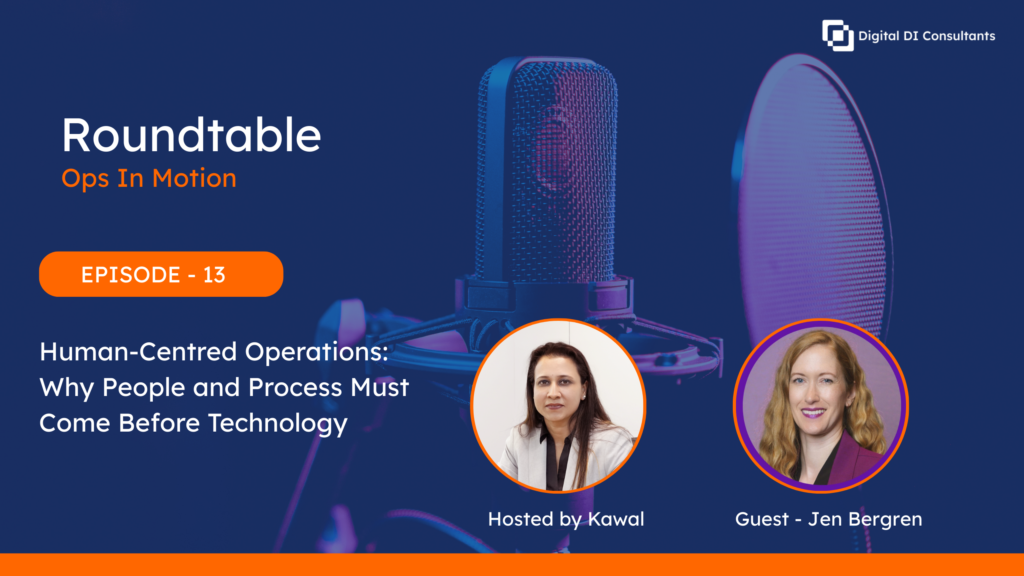
Episode 13
Human-Centred Ops: Why People & Process Come Before Tech with Jen Bergen
Human-centred operations puts people and process before technology. Buying software without fixing the underlying process first rarely solves anything — it usually makes the problem harder to see. Jen Bergren and Kawal discuss why MOps has no formal training path, where AI genuinely helps in day-to-day operations work, and what career options look like for practitioners today.

Jen Bergren
She has around two decades of B2B marketing and advertising experience. She designs education programs for companies focusing on learning, development, and enablement for marketers. She runs a weekly newsletter highlighting important topics in marketing and sales, and is an active member of the marketing operations community. She recently completed a master’s degree in instructional design and creates human-centered operations education programs including a free RevOps bootcamp focused on foundational skills like process mapping and project planning.
Transcript
Kawal: Hello, everyone. Welcome to the next episode of our roundtable series, Ops in Motion. I’m Kawal.
Kawal: Today’s conversation will be focused on B2B marketing, with topics related to marketing operations as well as the growing importance of community building within the marketing operations ecosystem.
Kawal: We have Jen Bergen here. She has around two decades of B2B marketing and advertising experience, and she’s currently involved in many activities. She designs education programs for companies, focusing on creating content for learning and development, education, and the enablement of many marketers.
Kawal: She also runs an amazing newsletter program. She highlights weekly topics that help many of us stay updated on what’s happening on social channels and what topics we should be aware of. I think this newsletter has been consumed by many marketing and sales professionals.
Kawal: Beyond that, I see that she’s an active and valued member within the marketing operations community.
Kawal: So Jen, good morning, and thank you for joining us today.
Jen: Thank you so much for having me on the podcast and inviting me here. Thank you so much for that wonderful introduction as well.
Kawal: Of course. Do you want to add something about yourself?
Jen: I think you did a great job introducing the many different but related things that I do around operations, education, sharing information, and trying to elevate and help other ops, marketing, and sales professionals.
Jen: I guess I should add that I live in San Diego, California, in the US — not Paris. I wish.
Jen: I would say maybe a common theme of the educational content I create is about human-centered operations. It focuses more on people and process before technology. As you probably have seen, just buying software by itself is rarely going to solve a problem.
Jen: So I try to bring attention to the other side of operations.
Kawal: Yes, I find it really valuable going through all of that educational content that you create.
Kawal: So Jen, since you’ve spent your career across different industries like advertising, creativity, and marketing — which are all connected — there are still some differences in the way things are done. As you move into more specialized industries and streams over time, how have you seen your work shift when moving from one process to another? And what are some things that have stayed the same?
Jen: I think it’s easier to look back and see all the common threads.
Jen: If anyone looked at my experience on LinkedIn, it probably looks like a wide variety of different things — different jobs, industries, and company sizes.
Jen: The short answer is that I love learning and doing new things. The common thread across all those roles has been operations-focused work, even though the jobs looked creative on the outside.
Jen: For example, my first career was in print graphic design. I worked on a daily newspaper, a weekly magazine, and weekly circular coupon inserts at a large retail company. It was all fast-paced, high-volume work with deadlines, mailing subscriptions, and a lot of project management.
Jen: We used templates and other tools for efficiency. I remember that my first three jobs had a software migration from Quark to InDesign, which was the major day-to-day software we used. Streamlining approval processes and solving problems quickly was part of the work.
Jen: Looking back, there was actually a lot of operations involved for someone with an art degree.
Jen: I was also directing photoshoots at those jobs, which made me interested in photography. So my second career was photography — running an art business. As you know from founding a business, that involves creating a lot of processes and running everything yourself.
Kawal: Yes, it has to be efficient as one person.
Jen: Exactly. I really liked learning about business and marketing because those were things I had never thought about before.
Jen: So I went back to school to get an MBA to learn more about businesses that are larger than one person. I really liked marketing and thought maybe my third career would be marketing.
Jen: Then I started working at Remotish, which was a HubSpot operations agency when it first started. I helped build the business and the operations foundation.
Jen: That’s when I learned about this word called operations, and I realized that this is what I had been doing the whole time. I just didn’t know the word for it.
Kawal: Yes, that happens with many of us. We all worked on some part of marketing operations but never knew that it actually fell under the umbrella of marketing operations.
Kawal: Later we realized how everything connects.
Jen: Exactly. A few years ago, I left the agency because I wanted to help more people faster — to scale my efforts in helping operations people across many companies.
Jen: I’ve been diving deeper into instructional design to create better education. I just finished a master’s degree in that.
Jen: One more thing about my career changes is that technology has disrupted many of those careers — design, photography, and marketing — at an increasingly fast pace. I know that will keep happening.
Jen: But I would love to hear about your career journey as well. From what I saw on LinkedIn, you’ve worked with some large companies and also co-founded a marketing operations agency. Tell me about your journey.
Kawal: Sure.
Kawal: It has always been interesting working with different organizations on the corporate side. They taught me how operations work at scale — complex processes, multiple stakeholders, and the importance of alignment.
Kawal: Most stakeholders have different opinions, and processes vary widely. So you need to bring together tools, people, processes, strategy, and technology.
Kawal: It was a great learning experience.
Kawal: I still remember when we introduced a new tool — Marketo. We had to set it up globally with stakeholders across different regions. Each region had its own requirements.
Kawal: I was part of the global team, so I had to speak with different regions to understand their needs. Change management was difficult because nobody likes change.
Kawal: Regional teams were already managing things their own way. Convincing them to adopt a new system was not easy.
Kawal: But over time, with discussions and documentation, we established ownership of processes and moved forward successfully.
Kawal: Co-founding a marketing operations agency was a big shift. Suddenly you are responsible for everything — strategy, execution, delivery, client communication — everything.
Kawal: At the beginning it was chaotic because you are juggling so many things. But it was also very exciting. You learn from mistakes and grow.
Kawal: Working in-house was focused on a few processes. As a founder, you have to manage everything end-to-end. But I really enjoy learning tools, technologies, and strategies while supporting the team and clients.
Jen: Yes, absolutely.
Jen: Now we keep talking about the evolution of AI in marketing and RevOps. Everyone is curious about how AI will add value.
Jen: What do you think about it?
Kawal: My final question — which I ask all my guests — is how marketing operations has evolved over time and what long-term career options exist in this field.
Jen: I think the fundamentals remain the same: communication, process design, and alignment.
Jen: But the pace of change is increasing because of technology.
Jen: I hope operations roles will gain more recognition in organizations. We’re already seeing more senior roles like VP of Operations.
Jen: Career paths could also include COO, Chief of Staff, consulting, or fractional roles.
Kawal: Yes, I’ve seen that as well. Fractional roles like fractional CMO or fractional RevOps are becoming more common.
Kawal: Marketing operations continues to evolve as new tools, technologies, and communication channels emerge.
Kawal: For example, earlier notifications were sent via email. Now everything happens instantly through platforms like Slack, which reduces response time and improves efficiency.
Jen: That’s a great point. The number of channels we manage has increased significantly.
Kawal: Absolutely.
Kawal: I really enjoyed our conversation today. It was great discussing marketing operations, its evolution, and its future.
Jen: Thank you so much for having me on the podcast.
Kawal: Thank you for joining us. It was really nice talking with you.