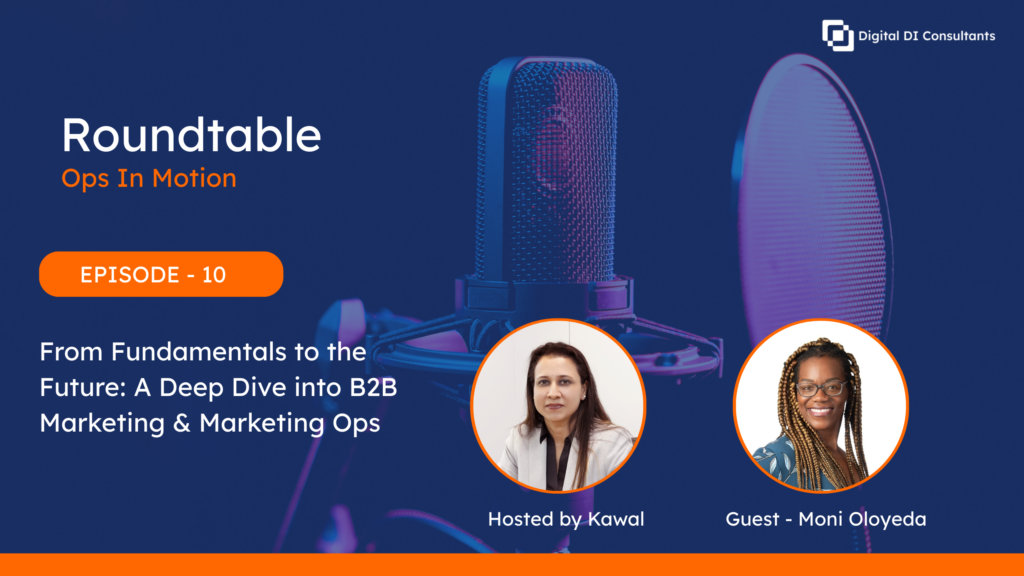
Episode 10
From Fundamentals to Future: Deep Dive into B2B Marketing & Ops with Moni Oloyede
B2B marketing technology integration is the practice of aligning core marketing fundamentals with automated systems to drive meaningful relationships rather than just capturing attention. By humanizing brands and implementing cross-functional data governance, organizations can maximize their MarTech stack utility beyond the typical 30% usage rate. This approach shifts the operational burden from individual specialists to collaborative committees, ensuring scalable growth and consistent customer experiences.

Moni Oloyede
She has close to 2 decades of experience in B2B marketing and is the owner and founder of Mo MarTech, a marketing operations agency. She is also the driving force behind DC Marketing Tech Talks, the largest marketing network in the DC metro area. She specializes in marrying marketing fundamentals with technology and advocates for strong messaging, market positioning, and relationship-building before relying on technology solutions.
Transcript
Kawal: Welcome to Roundtable Ops in motion, where marketing, sales and RevOps leaders break down the system, strategies and data shaping modern GTM operations.
Kawal: Each episode brings you actionable insights, practical frameworks, and emerging trends, helping B2B teams stay aligned, efficient and scalable.
Kawal: Hello.
Kawal: Welcome to the next episode of our roundtable series, Ops in motion.
Kawal: I’m Kawal.
Kawal: Focus on discussing B2B marketing and marketing operations, touching on various aspects along the way.
Kawal: Moni Oloyede has joined us with close to 2 decades in B2B marketing.
Kawal: She’s also the owner and a founder of Mo MarTech, a marketing operations agency and the driving force behind DC marketing tech Talks.
Kawal: Hey, morning, good morning.
Kawal: Thank you for being with us today.
Moni: Well, thank you so much for having me.
Moni: It’s a pleasure to be here.
Kawal: Thank you.
Kawal: So, before we dive in, could you walk us through your story?
Kawal: Like, how do you get started with B2B marketing?
Kawal: What inspired you to found Mo MarTech, and what excites you most about leading the DC marketing tech talks?
Moni: No, so my background in marketing and marketing ops is entirely happenstance.
Moni: When I graduated from college, I happened to work for a cybersecurity company that was an early adopter of Eloqua at the time.
Moni: They were customers, I want to say number 7 of Eloqua, so I got to learn lead scoring and lead nurturing and these marketing operation kind of concepts very early on, and was kind of the guinea pig for a lot of it.
Moni: And that company ended up switching from Eloqua to Marketo, so then I knew both systems, and I got, you know, poached to do consulting and the rest is kind of history.
Moni: Along the way, I realized I kept running into the same issues when it comes to marketing operations and, you know, revenue operations, you know, trying to get that golden pipeline dashboard of, you know, being able to say, you know, how marketing affected the bottom line.
Moni: And they were just keeping running into the same issues and the same issues and the same challenges, and I kept wondering, like, why is this happening? No matter where I go, I’m consulting, I see all types of different companies, shapes, and sizes.
Moni: I went back in-house, same problems, and I realized, once I peeled back the layers, that the marketing that was feeding the technology wasn’t good, it wasn’t strong.
Moni: You need to have very strong messaging, understand your market, your market position very well, and have a very tight offer that speaks to the audience.
Moni: Those things weren’t really happening; we were just sending a lot of emails.
Moni: So I decided to start my own business, kind of, Mo MarTech, really focusing on properly marrying marketing and technology, really focusing on what marketing is, what marketing is supposed to be doing, the fundamentals, because that’s what’s missing.
Moni: You can overly rely on technology and miss the marketing part.
Moni: It’s all about building relationships and really understanding people and feeding what they want back to them.
Moni: So that’s Mo MarTech.
Kawal: Thanks for giving the brief about Mo MarTech.
Kawal: It’s really exciting.
Kawal: I always see that your post comes on LinkedIn with that character with a braid, and she always has different expressions.
Kawal: That’s really exciting.
Kawal: I mean, the expressions that she gives resonate very well with the post that you post, the content.
Kawal: So it really, you know, it’s very exciting to see the post.
Kawal: So I actually waited some time for your post to come up to just see the character, to be honest.
Kawal: That’s really nice.
Moni: Thank you very much.
Kawal: I mean, you happen just to think like you want to use a character or you like thought about it, you started designing or playing in your head, like what I should put in my LinkedIn content that, you know, that actually people would, would actually like to engage with, right?
Kawal: Because we all post a lot of content, some content is just like, you know, paragraphs put in there.
Kawal: Some people can put.
Kawal: Like storytelling, and some can, as you put it, with the, you know, characters like that.
Moni: So, like one of the principles of marketing is people buy from people, right?
Moni: And your company’s brand is basically your version of a person.
Moni: So why not have a representation of that?
Moni: And that’s Mom is the name of my character, the eloquent elephant from my brand, and I want us to bring back core fundamentals.
Moni: Where I think Tony the Tiger or Ronald McDonald or these representations of brands and what they mean to that organization, and allows the company to live beyond the CEO, right?
Moni: It’s like not about that, it’s not about the face, it’s about the character, so that’s the essence of mom is sort of bringing back that old school marketing and having a relatable kind of person humanizing the brand.
Kawal: Right, very, very nice idea behind it.
Kawal: I liked it.
Kawal: OK.
Kawal: I’ve also seen that you have built an impressive rhythm of engagement for Ask Me Anything sessions that you do.
Kawal: Then you have hands-on workshops, and plenty of networking opportunities for the community.
Kawal: That takes an incredible amount of effort, time, and commitment.
Kawal: What strategies help you sustain that pace, and what passion fuels you to keep creating these valuable experiences and content?
Moni: Yeah, so I’ll answer the passion question first, which is that I really do have a passion for marketing.
Moni: I really want to be able to teach marketing fundamentals.
Moni: I really think it’s missing from the market.
Moni: A lot of people assume they know marketing and understand marketing.
Moni: What they really know is how to get attention, and that’s not really marketing, right?
Moni: Marketing is about people and about relationships.
Moni: The networking, the workshops, and the Ask Me Anything sessions are really just to connect with people.
Moni: I feel like one of the things I’m doing is teaching — I’m an educator at heart.
Moni: The Ask Me Anything sessions are an opportunity for people to really challenge my thinking.
Moni: And really understand my thought processes and how I teach.
Moni: There are some things you just can’t get across in a social or LinkedIn post.
Moni: Being able to do an Ask Me Anything lets me explain the reasoning behind it.
Moni: Sometimes on social media I can come off as anti-technology — I’m not.
Moni: I just want to put marketing and people first, and then the technology will work well.
Moni: So that’s why I love Ask Me Anything sessions — they’re about building relationships.
Kawal: Right.
Kawal: You said it perfectly — people first, not technology first.
Kawal: You can buy different tools, but nothing works without strategy, collaboration, and alignment.
Kawal: I completely agree with you.
Kawal: So let me ask you, what makes you passionate about marketing operations and RevOps?
Kawal: Why do you kind of do all this work?
Kawal: The way I see it, marketing operations and revenue operations are real powerhouses.
Kawal: They work behind the scenes to make go-to-market successful.
Kawal: It’s easy for teams to get caught up in their own priorities, right?
Kawal: Marketing is always chasing more leads.
Kawal: Sales is chasing quota and closing deals.
Kawal: Customer success is focused on renewals.
Kawal: Without operations, all these moving parts can pull in different directions.
Kawal: Marketing operations keeps everything grounded.
Kawal: They ensure data is clean, processes are smooth, and marketing aligns with revenue and strategy.
Kawal: They take big, messy ideas and turn them into systems that actually work.
Kawal: When that happens, campaigns going out the door are much more likely to succeed.
Kawal: Revenue operations takes this further by bringing marketing, sales, and customer success together.
Kawal: It helps teams see the customer as one connected story.
Kawal: That alignment makes handoffs seamless, forecasts more reliable, and customer experience consistent.
Kawal: That consistency was missing earlier.
Kawal: What really makes me passionate isn’t dashboards or shiny tools — it’s the impact operations create.
Kawal: When operations are done right, they free up time for teams to focus on strategy.
Kawal: Leadership can make informed, consistent decisions.
Kawal: In a world of tighter budgets and constant change, that clarity helps businesses move in the right direction.
Kawal: Without it, everyone moves, but no one moves together toward the goal.
Moni: How do you see the future of marketing ops and RevOps?
Moni: One reason I ask is because I run DC Marketing Tech Talks, the largest marketing tech network in the DC metro area.
Moni: We’re hosting an event about the future of marketing technology later this year.
Moni: In the past, we had conceptual frameworks like predictive analytics, dynamic content, and ABM driving technology.
Moni: I don’t really see that anymore — now it’s all AI.
Moni: AI is fine, but it’s not a conceptual framework on its own.
Moni: With fewer resources, less budget, and big data challenges, where do you see marketing ops going next?
Kawal: I feel AI is going to help us in many ways.
Kawal: It’s not just a buzzword — it will help take repetitive work off our plates and help us move faster and smarter.
Kawal: Think about all the manual tasks ops teams deal with every day — cleaning messy data, routing leads, pulling reports, building dashboards, forecasting pipeline across multiple spreadsheets.
Kawal: AI can handle a lot of that work, which frees us up to focus on planning, strategy, and improving customer experience.
Kawal: It can also help spot patterns we might miss — churn risk, top-performing campaigns, and even recommended next steps for sales.
Kawal: Earlier, we spent hours digging through dashboards and systems to answer simple questions.
Kawal: AI gives us a strong starting point — maybe 70% of the insight — and we apply human judgment on top of that.
Kawal: AI isn’t a magic fix.
Kawal: It’s only as good as the data and processes behind it.
Kawal: If your data is messy and teams aren’t aligned, AI will just amplify the mess.
Kawal: Strong operations practices, collaboration, and critical thinking will matter even more.
Kawal: To me, AI in ops is like a well-organized team with superpowers — removing busywork and helping us focus on what moves the needle.
Moni: Yeah, I agree.
Moni: My biggest concern has always been that you need good marketing fundamentals first for any of this to work.
Moni: I often think I’m preaching to my younger self.
Moni: We’ve all been in ops roles where we run the reports and execute campaigns and wonder why nothing is working.
Moni: You get handed bad copy and weak messaging and then feel responsible when performance suffers.
Kawal: Yeah, that’s absolutely right.
Kawal: So Moni, how do you feel about all these new shiny tools we see every week?
Kawal: With your experience in B2B marketing, what changes stand out most, and what trends do you think will define the future?
Moni: It’s a fascinating question because I see so many teams swallowed by technology.
Moni: Many companies only use 30% of their marketing automation platform’s capability.
Moni: They add more tools instead of fixing fundamentals.
Moni: CDPs are having a moment, especially with AI and journey orchestration.
Moni: Data will always be a challenge — it decays and changes constantly.
Moni: The typical stack is still a CRM, a marketing automation platform, and several point solutions.
Moni: Large vendors try to bundle everything, but it rarely works at full capacity and costs a fortune.
Moni: The biggest issue I see is that tech stacks are nowhere near optimized.
Kawal: Right, right.
Kawal: And when we talk to clients, they often say they want to use a new feature because others in the market are using it.
Kawal: But when we ask why, the real reason is often just that it’s new.
Kawal: Many times, Marketo or HubSpot already supports that functionality.
Kawal: Using what you already have avoids extra integrations and keeps data centralized.
Kawal: People get excited about shiny tools without understanding their purpose or value.
Moni: Exactly.
Moni: The promise we’re always chasing is better customer insight or better experiences.
Moni: But without fundamentals, none of that works.
Moni: A common misconception is that customers are just waiting to hear from you.
Moni: They’re not looking for your ad or your email — they don’t know you yet.
Moni: That’s why teams get frustrated by low open rates.
Moni: You have to build relationships first.
Moni: That patience is one of the hardest things for teams to learn.
Kawal: Yeah, I completely resonate with that.
Kawal: It’s something I’ve experienced many times.
Kawal: So what’s one piece of advice you’d give to someone in marketing operations based on your journey?
Moni: My advice would be this — it’s not all on your shoulders.
Moni: You’re not the savior of the marketing team.
Moni: Your job is to see problems and surface them, not fix everything yourself.
Moni: That’s something I wish I could tell my younger self.
Moni: You don’t control every part of the journey, even if everything flows through you.
Moni: And data is everyone’s responsibility — not just marketing ops.
Moni: Sales, finance, leadership — everyone has a role in maintaining data quality.
Kawal: Right.
Kawal: I remember when I started my career with Marketo, running campaigns and integrations.
Kawal: Whenever something broke between Salesforce and Marketo, I felt like I had to fix everything myself.
Kawal: Over time, I realized I wasn’t alone — I was working with a team.
Kawal: Everyone contributes value, and everyone has a role to play.
Kawal: Early in your career, you spend many late nights building reports and dashboards.
Kawal: You try to do everything to support leadership and sales.
Kawal: But eventually, you learn that collaboration matters more than overworking.
Kawal: Data quality is critical — what goes into the system determines what you get out of it.
Kawal: Even great content can fail if the data is messy.
Moni: Exactly.
Moni: As I’ve grown in my career, I now encourage shared ownership of systems like Marketo or HubSpot.
Moni: I’ve been the only person managing these platforms before, and it’s exhausting.
Moni: When something breaks, late nights become the norm.
Moni: It’s scary to give up control, but it’s incredibly helpful.
Moni: With documentation and training, others can support the system.
Moni: You can take time off without stress.
Moni: These tools are complex — don’t carry them alone.
Kawal: Yes, absolutely.
Kawal: This was a really insightful conversation, Moni.
Kawal: We covered a lot around marketing operations, data, and real-world experiences.
Kawal: It was great having you with us today.
Moni: Thank you so much for inviting me.
Moni: This was a lovely conversation.
Kawal: Thank you.