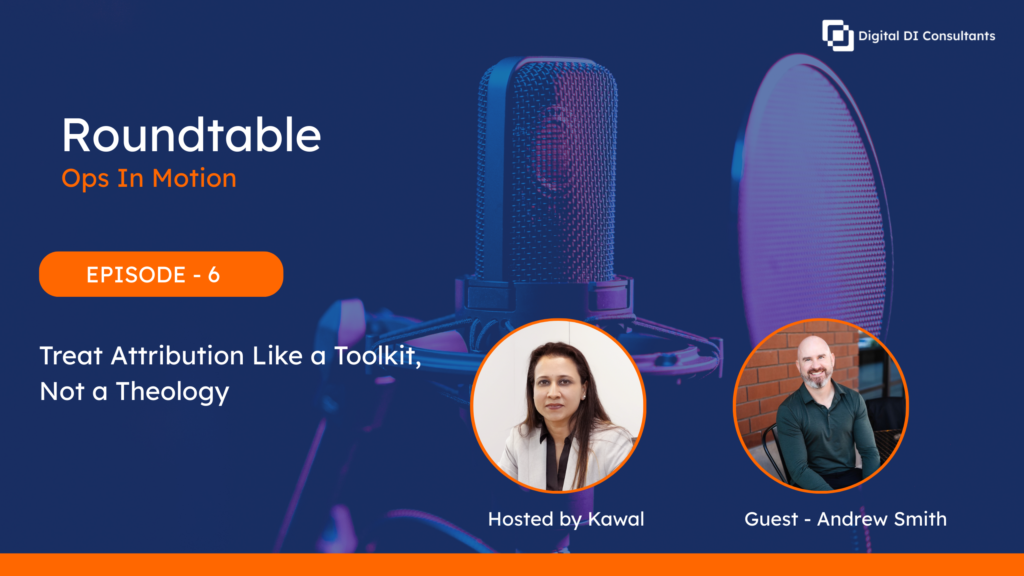
Episode 6
Treat Attribution Like a Toolkit, Not a Theology with Drew Smith
B2B marketing attribution requires treating models as tools for specific use cases rather than selecting a single company-wide standard. This roundtable explores why organizations should choose attribution models per report instead of per organization, ending internal debates over first-touch, last-touch, or multi-touch approaches. Learn how to manage martech stack challenges including tool adoption failures, integration complexity, and consolidation politics, plus how marketing operations evolved from tactical software execution to strategic business partnership driving measurable outcomes and AI-enabled growth.

Drew Smith
He is the founder and CEO of Attributa, a consulting firm specializing in B2B marketing attribution and measurement. The company has been in business for over 3 years since its founding in August. He also hosts the Attribution Nation Podcast and works with organizations to help them approach attribution models as tools for specific use cases rather than a one-size-fits-all solution.
Transcript
Kawal: Hello.
Kawal: Welcome to the next episode of our roundtable series, Ops in motion.
Kawal: I’m Kawal, co-founder and CEO at Digital DI Consultants.
Kawal: We are guiding our conversations around B2B marketing, specifically attribution.
Kawal: Now, we have Drew Smith join us.
Kawal: If you are from marketing operations and web operations, you would already know him.
Kawal: He’s a founder and CEO at Attributa.
Kawal: And he also hosts a fantastic podcast called the Attribution Nation Podcast.
Kawal: So hey, good morning.
Kawal: Thank you for being with us today.
Drew: Good morning.
Drew: Thanks for having me.
Drew: Excited to talk with you today.
Kawal: Yeah, looking forward to it.
Kawal: So, so Drew, can we start with a small introduction about yourself?
Drew: Yeah, so, as you mentioned, I am a founder.
Drew: I’m the CEO and founder of Attributa.
Drew: We’re a consulting firm that specializes in B2B marketing attribution and measurement, and we do a lot of other types of consulting as well, but that’s really kind of like our niche and our specialty.
Drew: We’ve been in business now for a little over 3 years.
Drew: We just hit our 3rd anniversary in August, so yeah, we’ve been around for a little bit.
Kawal: That’s nice.
Kawal: I mean, this sounds interesting, 3 3-year journey on attribution.
Kawal: I mean, attribution is always fascinating because people look at it in different ways, people use it in different ways, and they have different perceptions about it.
Kawal: Thank you for the introduction, Drew.
Kawal: So, I mean, working on these things, how has your evolution been from working with some of the fantastic companies in the past, and now you’re being a founder and the CEO of a successful agency, running those attributions and working on different other things.
Drew: It’s, it’s been quite a journey, honestly.
Drew: I never, if you had asked me, you know, 10 years ago, 15 years ago, if I would have started a company, I would have said, said no.
Drew: I never had the designs to be an entrepreneur and start a business, so it’s, it’s been quite a journey.
Drew: I’ve learned so much.
Drew: It’s, it’s wild how when you start a business, and you learn how much you don’t know about starting a business, and so it’s been a journey.
Drew: It’s been a lot of learning, some, you know, some.
Drew: Some incredibly stressful moments, just a lot of stuff that you never knew you’d have to deal with, but you now have to deal with.
Drew: But I say that also to say it’s been gratifying.
Drew: I am, like I said, I’ve learned so much.
Drew: I get to, you know, impact.
Drew: The clients that we work with, I get to build up a team and help them achieve their career goals.
Drew: And yeah, I mean, it’s just been gratifying.
Kawal: Yeah, I can understand.
Kawal: Like, it seems so easy to start a company on paper, but when you actually get into it practically, you explore, and you learn, and you tell it to different things.
Kawal: That’s like too much sometimes.
Kawal: Yeah, I totally resonate with it.
Kawal: So, I mean, thank you for sharing the transition.
Kawal: I love the transition that you spoke about.
Kawal: Topics like attribution have always been the talk of the town because they provide an interesting understanding of how your marketing and sales efforts are moving the needle, right?
Kawal: So, yeah, I mean, this topic has evolved a lot in the past.
Kawal: Like it was, it was a difficult needle to crack, but I mean, still it is, but somehow people have evolved, and they have understood a bit about this.
Kawal: So that’s been really interesting.
Kawal: And I think with the use of AI and evolution of the tools, maybe we have a lot of learning and agencies like you could obviously add more or throw light on that, definitely.
Drew: Yeah, we’re certainly hoping, we’re certainly hoping we can.
Drew: So now, Kawal, you’re on a similar journey.
Drew: How’s your, how’s your progress been towards, you know, how’s your journey been towards being a co-founder of a marketing and RevOps agency yourself?
Kawal: Oh yeah, I mean, I would say it’s a journey of unlearning, relearning, and stepping into much bigger shoes.
Kawal: So it’s like, no intention, like one intentional step at a time.
Kawal: So for years, I was the one executing campaigns, optimizing CRM workflows, managing data hygiene, and troubleshooting sync errors at like 8 p.m., my day.
Kawal: So we’ve all been there.
Kawal: And doing those implementations and migrations.
Kawal: I mean, I love the execution that we did, I still do, but as I started seeing like strategy or system and scalability are like intersect, I realized that I didn’t just want to do this.
Kawal: I just didn’t want to do the work, but I want to build a team or the environment where the great work could happen, and that’s when I pushed myself to found a company, for marketing ops and RevOps agency, and the shift I see was like, how do I do this to like, how do we build this?
Kawal: It was more of like, Or more than taking care of day to day activities or, fixing things or, you know, building processes, it was like how we position the agency in the market, you know, make a brand and how do we make or get the clients on boarding seamlessly and how do we build repeatable frameworks for other MOPs or RevOps or pros so that they can.
Kawal: Use it or thrive in it, right?
Kawal: And how do we protect ourselves, as you said, our mental health, while doing all of this?
Kawal: I mean, this is like too much.
Kawal: You were just executing and doing things in a company, and now you’re like everywhere you have to take care of everything, the HR, the admin or talking to the clients, fixing those, you know, invoices and everything from starting to end.
Kawal: I mean, I am also still learning a lot, and I feel like I’m learning more about leadership, about how we design the team and the pricing and client success.
Kawal: I feel.
Kawal: What’s exciting is like, I started from scratch, building on every campaign and all of that, and now I get to build with a purpose with my team instead of just doing it individually, right?
Kawal: An individual contributor, so I’m like building it up with the team, with the people, and getting better on it day by day.
Kawal: But there is still a lot to do, right?
Kawal: The foundation is just built, and I think I’m progressing towards my goal.
Kawal: So that makes me really happy that even though I’m learning, I’m progressing towards my goal, which makes me really happy.
Drew: Yeah, I think one of the things that I kind of preach to my team is, you know, just be 1% better every day, that, that growth and that, that learning curve.
Drew: You don’t have to, you know, make big jumps.
Drew: You can learn just 1% more every day and make those little improvements, and over time, suddenly you’re coming an incredible way just by getting a little bit, little by little.
Kawal: Yes, yes, of course.
Kawal: So when I started working on marketing campaigns, they were like HTML coding that was needed to fix those renderings and all that.
Kawal: I was not from a coding background, but we all learned those tweaks and all that over the period of time.
Kawal: So that’s how we made ourselves better.
Drew: Yeah, you just have to kind of experiment with stuff and play with new things.
Drew: I didn’t know code when I started working in Marketo, and you know, working in email templates.
Drew: I had no idea.
Drew: I just, you learn things.
Drew: I still couldn’t build an email template from scratch, but I know.
Drew: At least fix it, right?
Kawal: Yeah, I mean, same here.
Kawal: We cannot learn the entire stack, but then at least, you know, a little bit of fixing here and there that would help, of course.
Kawal: So, I mean.
Kawal: Let’s talk about one of the interesting topics, which is attribution.
Kawal: We have seen the organization constantly debating about the first touch, last touch, multi-touch, or custom attribution models that they like to build.
Kawal: So, from your perspective, since you’ve worked 3 years on this with your clients, with different types of clients, different industries, so what’s the biggest misconception that the organizations have like about the attribution model?
Kawal: And how should companies approach choosing the right one?
Kawal: What’s your perspective on that?
Drew: See, that’s the thing.
Drew: My perspective is that there isn’t a right one.
Drew: There’s no one model that is the right model for your organization.
Drew: What organizations need to do is they need to view attribution models as tools, and each tool has its own use case.
Drew: So the analogy that I always use for this is, it’s like if you go down to the store and you buy a set of wrenches, you buy a set of 5 or 6 wrenches, and each wrench is a different size, and it fits a different size bolt, right?
Drew: What do you do when you buy that set of wrenches?
Drew: Do you go home, pick your favourite wrench, and throw the rest of them out?
Drew: No, you don’t.
Drew: You can’t do that.
Drew: You use the wrenches for their intended use case.
Drew: That’s the way that you need to view attribution models.
Drew: Each attribution model is a unique wrench that fits a specific use case, and so you use that attribution model for its use case.
Drew: This also, like, we see a lot of organizations that basically get paralyzed in their attribution journey because they’re trying to pick the attribution model that’s right for their organization, and they get into all these internal battles, and everybody’s got an opinion about which model it should be.
Drew: And if you just approach it from the standpoint of no, we’re not picking a model for our business, picking a model for the individual report, if you change your perspective to that.
Drew: It makes There are no more battles.
Drew: You don’t have to argue with people over which model we’re going to pick as a company, and you can actually just get started building reports and just get started using your data as opposed to wasting all this time arguing over which attribution model is the right one for us.
Drew: It’s the biggest misconception, easily the single largest misconception that organizations have about attribution models is that they think it’s, they, they think they have to pick one for their organization, and you just, you don’t.
Drew: It’s, you pick it for the report, not your organization.
Kawal: Yeah, I mean, you got it right, and you, you know, explained it very well.
Kawal: I think some of the client calls I have seen, they would be like, OK, I was using the shape model that was their HubSpot, and I would like to go about that.
Kawal: I think that’s the best, that works best for me.
Kawal: Past organizations, and I would like to go with that because that gives me this and that gives me this.
Kawal: But then we were like, OK, that was for this use case, right?
Kawal: So it does not fit into this model, but they would be like, OK, we have this preference, why don’t we try this?
Kawal: It’s like, OK, you try this for this use case, as you rightly mentioned, right?
Kawal: But you do not fit into everything that you do in your reporting, right?
Kawal: So yeah, sometimes it becomes their perspective, and sometimes they do understand and try to accommodate to that.
Kawal: So yeah, attribution has always been interesting.
Drew: That’s what it is, yeah, for sure.
Drew: So you know we’re talking about attribution, and obviously, attribution is just one tool that goes into a modern-day marketing tech stack.
Drew: So question back to you is, you know, with so many tools and technologies available, what’s the most challenging part of managing a Martech stack today?
Drew: Is it adoption, integration, or consolidation?
Kawal: Oh, honestly, that’s a bit of a tricky question because they all seem to be interconnected, but I would choose to say that adoption is the biggest challenge these days.
Kawal: Why?
Kawal: I mean, not only today, but it has been all the time.
Kawal: So why?
Kawal: Because adoption isn’t just about buying and implementing the tool.
Kawal: You have to embed it into the processes, getting the team aligned on how and why to use it, and measuring the value over time.
Kawal: So what we have seen is, companies invest in best-in-class platforms, and they just, you know, but adoption fails because no enablement is done beyond the launch of the tool or the application that they buy.
Kawal: And then the tools sometimes overlap with the ones that they already have in-house that they’re using it and sometimes it does not integrate into teams’ existing workflows.
Kawal: They have some way of working, and it does not fit into that.
Kawal: So, and once adoption fails, integration and consolidation become even messier.
Kawal: So that said, integration is like a very close second.
Kawal: So, with so many tools in the stack, even a simple data flow can become complex and challenging to manage if it is not handled intentionally.
Kawal: So,
Kawal: Think of one misfiring webhook or duplicate field mapping can disrupt the reporting and lead routing very quickly.
Kawal: It, it’s just a fraction of a second, it can do that.
Kawal: We try to avoid this by taking something called a minimum viable integration approach first.
Kawal: So, what we do is we try to connect what is really needed, test the workflows, and expand from there.
Kawal: So that helps us, giving us the stage, the platform, which is like there for us to start from, instead of getting everything plugged in and everything.
Kawal: Like boom, broken and coming to consolidation, it’s becoming more urgent but also more political, I would say.
Kawal: Everyone wants to wants fewer tools, but no one wants to give up the tool that they have actually, you know, worked on or they were like champions in that, so they do not want to go with the next tool that could be good for their current job profile or personas or the requirements.
Kawal: So we treat consolidation like product sunset and try with, you know, looking at usage audit.
Kawal: And score the value that’s provided, then the internal alignment, the migration plan is created, and then we have communication and the training done with the client team.
Kawal: So, solving one often reveals another problem, or just sometimes breaks it.
Kawal: So it’s less about choosing one to fix.
Kawal: It’s more about managing the entire tech stack life cycle intentionally.
Kawal: So that’s how, you know, I would see it.
Kawal: And that’s how I think maybe we can make it work.
Drew: Yeah, I think approaching this question from a standpoint of an attribution system or an attribution platform, for me, the single most significant challenge is adoption.
Drew: We see so many folks that that board and have a successful onboarding with an attribution platform, and it’s set up correctly.
Drew: And then the next step is like, OK, cool, we got all this great data and all this great information.
Drew: How do we use it?
Drew: Yeah, I would say, from an attribution, purely attribution platform perspective, adoption is, is easily the biggest challenge.
Kawal: Yeah, I totally agree with that.
Kawal: They buy it.
Kawal: They just place it in the system somewhere, or it’s like the CMO wanted some fancy tool, and they’re just like, OK, I want this tool to be in our system, and I want the team to use it.
Kawal: They get into their team, and the team is like, Hey, we are already using it.
Kawal: I do not like this tool.
Kawal: So that tool is like sitting somewhere in the system, nobody is using it much.
Kawal: Yeah, that’s always the case.
Kawal: So true, I have one more favorite question of mine that I kept asking most of my guests.
Kawal: Seems like how you feel that marketing operations have evolved, and what are the long-term career options that you feel any marketing pro-ops can have?
Drew: Yeah, I mean, you know, one of the ways, I think the most significant way that I’ve seen marketing ops evolve is it’s gone from a very tactical software-based discipline.
Drew: You know, you come in, you build an email template, you get the email out the door that used to be marketing ops.
Drew: Now marketing ops is so much more than that.
Drew: When done correctly—and we have to put that caveat in there—marketing ops is a strategic partner in the organization.
Drew: They have a much larger impact than just building emails and getting them out the door.
Drew: And so to me, marketing ops transitioning from this really tactical software-based type of role to more of a strategic role that is driving.
Drew: You know, significant business outcomes.
Drew: I think that’s been the most significant transition.
Drew: In terms of where I think there are long-term career options here, you know, personally, I’m not on the same page as folks who are screaming doom and gloom for marketing ops because of AI.
Drew: Part of that is just, it comes down to, there are certain things that AI just cannot do that you have to have human eyes on.
Drew: And so, until AI is sophisticated enough to be able to, you know, build out a strategic business process workflow, your guys are not gonna replace a marketing ops person.
Drew: That being said, I do think from a long-term perspective, integrating AI into what you’re doing from a marketing ops, you know, team member and from a marketing ops charter is gonna be incredibly valuable.
Drew: We are. You’ve got this new concept of a go-to-market engineer that Clay is really pioneering.
Drew: I don’t know if that’s gonna have legs and survive, but, but the thought process behind it of Integrating AI and integrating even more automation into what we’re doing from a marketing ops perspective, I think that is going to be the long term kind of like growth path or long term kind of like what’s going to make a marketing ops person successful is, is that.
Drew: Now, long term, I do think that you’re going to see more marketing ops folks getting into positions of leadership in marketing departments because they are going to be really on the leading edge of AI adoption.
Drew: Integration in organizations, it’s going to give them an advantage over other folks in the marketing organization that you know may not be using AI at all, outside of you know, copy and images, so I think that you’re starting to see.
Drew: Some marketing ops roles that are higher up the food chain and bigger types of leadership positions, and I think that’s just gonna continue.
Kawal: Wow, that’s interesting.
Kawal: I mean, that sounds interesting for most of them, I think, and AI is just, just there, and we are talking about AI, but again, as you mentioned, and I also agree with that, that, you know, it just, it’s not gonna have the intelligence of humans to decide to make decisions.
Kawal: For example, you just take an example of attribution.
Kawal: So AI is not gonna understand which attribution fits into which use case, right?
Kawal: So it’s gonna just.
Kawal: Do like, OK, do this model.
Kawal: So AI is gonna go and help you with that, but it’s not gonna be able to take that decision what fits right into this scenario and how do we build this process, how to make this easier for the team, but you can obviously give prompts and make it work like agent Force, so you can give instructions and build something that they can repeatedly keep doing it every day for you, but then taking that decisions and building on their own would be really difficult.
Kawal: So yeah.
Kawal: That’s really right.
Kawal: So, yeah, I think we had a lovely discussion about AI marketing operations and then attributions and marketing tech stack, how it is managing, how it is changing, and all of that.
Kawal: So, I think these topics were exciting too.
Kawal: Talk about, and it really focused on what it takes to scale with both systems and the people around us.
Kawal: Definitely, we need all of them.
Kawal: I mean, thank you, Drew, for joining and sharing your practical insights on some of those things like attributions and your journey and all of that.
Drew: Well, thank you for having me.
Drew: Appreciate it.
Kawal: Sure.
Kawal: Thank you.s