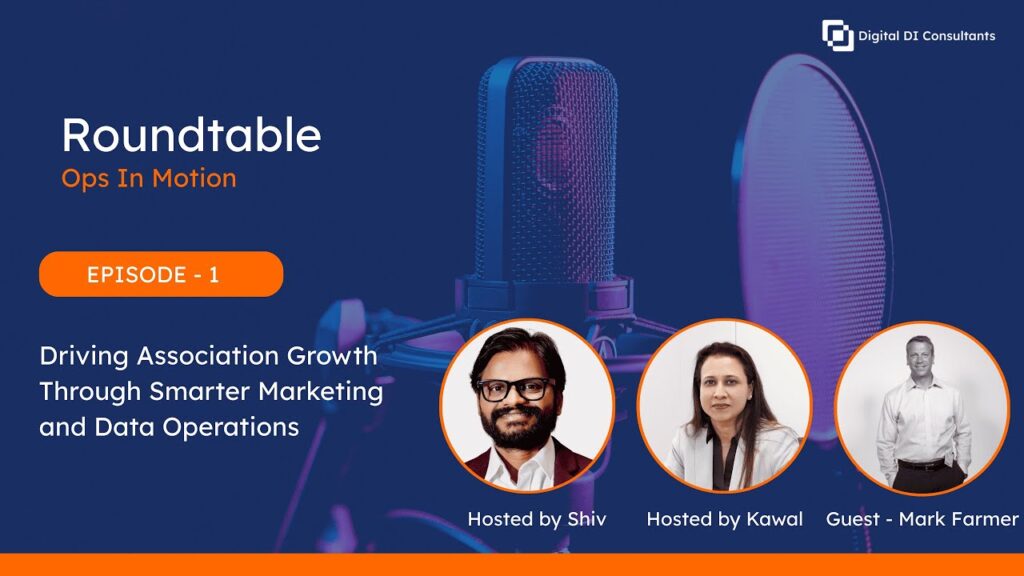
Episode 1
Transforming Marketing & Data Operations in Associations with Mark Farmer
Trade and professional associations face unique marketing operations challenges. This roundtable with association consultant Mark Farmer explores how proper CRM database management, continuous ICP refinement, and strategic marketing operations enable associations to maintain stakeholder relevance, optimize technology investments, and drive sustainable membership and revenue growth in evolving industries.

Mark Farmer
He is a veteran consultant specializing in generating sustainable revenue sources for non-government related industry, professional, and trade associations. His role allows him to work both strategically at a high level and operationally on a daily basis, helping association clients succeed and grow.
Transcript
Kawal: Hello, Mark and Shiv.
Kawal: Welcome to Roundtable Ops in Motion, Episode One.
Kawal: Today, we have Mark Farmer, a veteran consultant to associations, and we will be deep diving into how data operations and marketing operations should work in associations.
Kawal: So, hey, Mark, can you please introduce yourself?
Mark: Sure, Kawal, it’s nice to see you and Shiv again.
Mark: Always nice.
Mark: Thank you.
Mark: So, my firm is Access Marketing and Events.
Mark: Our firm specializes in generating sustainable sources of revenue for non-government-related industry, professional, and trade association clients.
Mark: In terms of myself, I love my role as managing partner.
Mark: It allows me to be entrepreneurial with my clients at a high level strategically, as well as that boots on the ground position of getting things done on a daily basis.
Mark: And I have to say it’s been very rewarding for me to see us succeed alongside our client partners over the years.
Kawal: Excellent, Mark.
Kawal: Thank you, and of course, nice meeting you again.
Kawal: An important question for you, Mark.
Kawal: I mean, you’ve been serving the association industry globally for a very long time, and I’m sure you’ve had a chance to work with some of the great associations.
Kawal: So, what do you think are some of the challenges associations are facing today, and any additional details that you would want to provide, especially in terms of marketing?
Mark: Hm, sure.
Mark: That’s a loaded question, Shiv, but I, two things that come to mind to answer that question.
Mark: First is there has been a real challenge for associations across diverse landscapes that are changing consistently, for our association leaders today and for marketing operations teams.
Mark: I think it’s been a really good challenge to always present that clear voice of the association.
Mark: To maintain their relevancy with their existing and emerging stakeholders.
Mark: We’re finding that it also comes down to the basics of listening, really listening intently or similarly, listening with intent.
Mark: And what I mean by that is, it’s really diving in with the clients, industry partners, understanding what is important to them strategically at a very fundamental level?
Mark: What are their objectives, and where do those objectives and initiatives intersect with the work that your association is doing?
Mark: And then you say, Great, let’s expand on that, or let’s work together to co-create Something in that area of intersection, and then you take two ideas and make them even greater.
Kawal: Wonderful.
Kawal: It’s the relevancy that’s pretty, pertaining to any industry, and especially with the associations today.
Mark: Yes, it’s also, you know, causing us to create new opportunities in terms of new channels, new programs, new assets, and those things, I think, continually drive the growth and the opportunity for associations.
Kawal: Absolutely.
Kawal: Hmm.
Mark: Shiv, I’d like to ask you a similar question or the same question.
Mark: You know, you’ve worked with a few associations, and what have your observations been?
Shiv: That’s a good question, Mark.
Shiv: Well, I’ve been lucky enough to work with some associations and some associations along with you.
Shiv: Associations kind of tend to carry out the marketing efforts that they’ve been doing for a very long time, which works amazingly well for them, right?
Shiv: And, and as they say, you’ve got to do what’s working for you.
Shiv: However, at the same time, I’m a firm believer, it’s always good to add on new technologies or add on to new services or a new agenda that would eventually help you to grow.
Shiv: And when it comes to marketing and sales, it’s the basics that remain the same, right?
Shiv: One thing I would definitely want associations to really work on is getting their CRM database absolutely up to date.
Shiv: Unfortunately, that’s not been the case with a few of them.
Shiv: For many obvious reasons, right?
Shiv: I mean, it’s more of catching up with the new age technologies, how you want to maintain the CRM database.
Shiv: I was listening to this, from someone, very recently, Mark, and they said, CRM is just not about maintaining customer relationships today, right?
Shiv: It’s about how you understand your CRM database, how you predict your CRM database, and eventually, how you adapt to it, right?
Shiv: I think that’s a need of the art when you’re able to adapt to your CRM database, which eventually helps you expand the horizon that you would essentially want to go after and help you grow your business.
Shiv: So that’s definitely part of the thing that I’ve been seeing with associations, whenever we talk to them, this is definitely 11 subject that we wish to talk about.
Mark: Wonderful.
Mark: So in that same vein, I have a question for you, Shiv, about data hygiene.
Mark: First off, how important is data hygiene in terms of maintenance, and how is weak data hindering even the best-run associations?
Shiv: Well, It’s the same, Mark, a few things just do not change, and one of the fundamentals for any organization to grow is, is your, is your CRM database, right?
Shiv: So that’s the one place where you maintain the database of your existing customers and your potential customers. I sometimes call them, you know, future customers.
Shiv: Now, if you do not maintain.
Shiv: Your database in a way that would eventually help you to execute the marketing programs or the sales programs, or the customer service relationship program that you have, everything kind of boils down to the company’s bottom line.
Shiv: It affects the revenue of your organization.
Shiv: So it’s very fundamental for associations to maintain the CRM database absolutely clean and hygienic.
Shiv: Many of them still struggle to maintain the database the way it should be.
Shiv: That’s again got to the kind of practices that they’ve been following for a very long time.
Shiv: And, and that’s where people like you and, and, and us kind of come into the picture, to educate them on the importance of having a very clean and up-to-date CRM database, which would eventually help them.
Shiv: To, to get them where, where they want to be, right, and, and for that to happen, a clean database is, is, is absolutely mandatory, and you cannot have to have, you cannot offer to have a weak database.
Shiv: So that’s, that’s been the observation and particularly the same data question or the topic that we have been discussing, Mark, I think you’ve been one of the big proponents of CRM database, right?
Shiv: So, please help us understand.
Shiv: What do you mean by TAM or ICP, and how important is it for an association to get that, that is TAM or ICP, absolutely correct, which eventually will help them to go to the next level with the activities that they want to?
Mark: Sure, I’ll break that out into two parts of the question.
Mark: First, I’ll talk about ICP and TAM, and then I’ll talk about why it’s important, and how to put it into practice.
Mark: So, first and foremost, the ICP is known as the ideal customer profile.
Mark: It’s really similar to that old-school methodology of ranking your prospects, ranking your customers.
Mark: Some people even focus on and still use methodologies like RFM, recency, frequency, and monetary value to rank their customers and to rank their prospects.
Mark: Once you start to hone in on your ICP, then the total addressable market becomes an idea or a way of measuring.
Mark: Your ICP across industries, across regions or across geographies.
Mark: And it’s really starting to be able to size the market.
Mark: You can be able to start to forecast your sales, your market penetration, your market share, and all kinds of basic planning and blocking of your company and your strategies can rely on that TAM or the total addressable market that is founded in finding out and learning more about what your real ICP is.
Mark: So, so then let’s talk about how we make this effective, right?
Mark: So the number one piece of advice I would give is making sure that you truly understand your ICP and spending time with it.
Mark: This isn’t Something that you get a brainstorm together, you come out an hour later, and everyone understands their ICP.
Mark: This takes time.
Mark: You have to understand that.
Mark: You understand that it’s constantly evolving.
Mark: And as well, because it feeds total addressable markets, that too is evolving.
Mark: So, understanding that ICP and TAM are constantly and continuously evolving.
Mark: Number 2, spending adequate time with your ICP algorithm.
Mark: As I said, this isn’t Something that you do in a vacuum.
Mark: It’s not Something that you do on the back of a napkin.
Mark: It’s Something that you develop over time.
Mark: It’s a recipe for success.
Mark: So you want to constantly enrich it, test it, change it, iterate it and get it to the point where you really feel as though you have a good handle on that, but realize that you have to continuously challenge that.
Mark: There’s one other thing that you need to challenge, and that’s your status quo thinking.
Mark: The things that got you to where you are today aren’t going to get you to where you’re going tomorrow.
Mark: That can also be said about some of your customers, especially your emerging markets.
Mark: So you need to develop an ICP algorithm that you can revisit on a regular and consistent basis.
Mark: Hmm.
Mark: OK.
Mark: The other thing that happens when we see the status quo thinking is this inertia.
Mark: Everyone’s familiar with it.
Mark: Maybe they can’t put their finger on it.
Mark: Maybe people see symptoms of inertia by saying, We hear the same thing, over and over, when we ask, Why do you do that?
Mark: It’s because we’ve always done it that way.
Mark: That’s a mere symptom of Something that we call that inertia.
Mark: So whenever you feel that inertia, I would challenge folks to dive in there and try to find a way to disrupt that.
Mark: There are different ways of disrupting that inertia that can actually be beneficial.
Mark: It’s not always detrimental.
Mark: That type of thinking and that challenging can breed really good new ideas.
Mark: And then lastly, number 4.
Mark: Maintain a closed-loop system for your TAM and your ICP models.
Mark: So that intelligence is constantly being fed into your algorithms and changing it.
Mark: Sometimes it’s in the form of AI, sometimes it’s in the form of human intelligence as well.
Mark: So, that’s actually going to bring me to Something I want to talk about a little bit later in terms of artificial intelligence.
Mark: But yes, I would say that when you maintain really good closed-loop systems for your TAM and your ICP models, they’ll always render excellent results.
Mark: Right.
Mark: Yeah.
Kawal: Kawal.
Mark: If I may, I’d like to ask you a question about how you see the changing role in marketing operations in industry, trade, and professional associations.
Kawal: Sure.
Kawal: So first of all, thank you, Mark, and the brief or the understanding that you give about the TAM and ICP, and I can see how data operations are so well connected with marketing operations.
Kawal: And yeah, of course, the role of marketing, or what we also call MPs, in association has undergone a big shift.
Kawal: It has been driven by digital transformation, so marketing operations are now becoming the strategic engine powering modern association marketing.
Kawal: So MPs have moved from support function to becoming a strategic growth enabler, and marketing operation is no longer just the team behind, you know, sending email blasts or doing database cleanup.
Kawal: They are becoming a central hub for data-driven decision-making of audience engagement strategies and tech stack optimization.
Kawal: And in this process, we have seen, or I have rather seen, 5 key changes that happen.
Kawal: The first one is data-led audience engagement.
Kawal: So, mop teams are helping associations turn data into action, so that they are segmenting audiences more effectively.
Kawal: They are targeting niche segments based on industries, revenue, etc.
Kawal: They are personalizing outreach.
Kawal: They’re sending personalized emails or running personalized ads, and then tracking the engagement across the lead life cycle.
Kawal: , and the second one is the use of automation and AI adoption.
Kawal: So there’s a growing demand for scalable marketing.
Kawal: MPs is now leading the charge in adopting automation and using the AI to, to manage their campaigns to reduce the manual efforts that was there in the past, and predict what would be the next step, to keep all the processes aligned within the organization, and they’re also creating more of automation alerts that helps you keep things in track and you see if things are going or derailing from the processes and that has to be done, so they are taking care of that.
Kawal: The third one is that Mops is taking charge of strategies.
Kawal: So associations are seen investing more in sophisticated CRMs like HubSpot, Salesforce, and marketing platforms like Marketo, Pardot, and analytical tools like Tableau to get a better understanding of their marketing and sales.
Kawal: So now marketing operations owns and optimizes those tools instead of just using them.
Kawal: So that’s the shift we are seeing.
Kawal: And the fourth one is that the MPs are able to provide the ROI and performance transparency.
Kawal: So the board and the leadership want to always know, like what’s working and how it’s working.
Kawal: So, MPs are becoming the key in building those dashboards, defining the KPIs, and showing the value of marketing in concrete terms.
Kawal: And this is really helpful for the leadership because it’s, it’s so useful for them to see the visibility, reports and the visibility into these systems, so they are able to provide that visibility into marketing and sales processes, which is very much aligned with the business school.
Kawal: And the 5th 1 is MPs are helping in cross-functional alignment.
Kawal: So, marketing operations is a bridge between different departments and associations.
Kawal: So they are connecting the marketing, the membership, they are educating teams and events with consistent data, workflows and tools.
Kawal: So this helps.
Kawal: Aligning the team and the processes together within the organization.
Kawal: So in short, I would say marketing operations in association is shifting from executional to transformational.
Kawal: It’s becoming the operational brain behind the smarter, more sustainable audience of growth.
Kawal: So this has been my observation while working with different organizations.
Kawal: So, Mark, what are some of the challenges within the association with regard to the use of technology, within marketing?
Mark: I’d have to say, Kawal, I’d have to say, piling on technology without a roadmap.
Mark: We’re seeing a lot of technology stacks out there that are not fully understood.
Mark: This is creating silos of data, and it also leads to decentralized dashboards that can’t be optimized for prescriptive data execution strategies.
Mark: How about your opinion, Kawal, on specific data analytics?
Mark: How important is data analysis within marketing these days?
Kawal: OK, that’s a great question and a crucial distinction, I would say.
Kawal: Within marketing operations, data analysis isn’t just important; I think today it’s fundamental, because data analysis turns operations into task-based support to a strategic growth engine.
Kawal: And there are 5 key data analyses I feel are really important for marketing operation success.
Kawal: The first one would be driving measurement and accountability.
Kawal: So marketing operation is responsible for defining, tracking, and reporting on KPIs that actually matter, like pipeline contribution, then you have campaign performance, then you have channel ROI.
Kawal: Without strong data analysis, marketing would stay a cost center.
Kawal: So with it, Mops is able to prove that or improve the value of the marketing that they are doing today.
Kawal: They’re able to optimize processes and align things together.
Kawal: The second point would be, data analysis is able to empower strategic plans, so marketing operations can actually take guidance from the data analysis for budget allocation, for resource planning, for campaign prioritization, for lead scoring, and routing logic.
Kawal: So I would say, in short, it’s like better data analysis would lead to better decisions.
Kawal: And the third, change or the key point would be data enable continuous optimization.
Kawal: So data isn’t just, you know, giving us the information about the past, what has happened.
Kawal: We are also able to take some strategic action.
Kawal: We are also able to understand, like what’s going to happen in the future if we follow the same strategy.
Kawal: If you are going the same route, what is gonna happen in the future?
Kawal: So that also is very helpful.
Kawal: So MPs use these data analysis to test, to iterate and refine everything, starting from email workflows to the attribution models.
Kawal: And the analysis is also, you know, it’s helping connect the dots across systems.
Kawal: So marketing operations sits at the center of the Martech stack, that’s the CRM, and the marketing automation platforms, and there are other tools as well in the process.
Kawal: So data analysis ensured that these tools.
Kawal: Talk to each other, or they are aligned together so that we get support, unified reporting, which is really important because if one process or tool breaks, then the whole process is broken, and we cannot see the journey of the customer or the lead across the pipeline, right?
Kawal: So, which is not good?
Kawal: And then the fifth one is, MPs, I mean, data analysis helps MOPs to become a strategic function.
Kawal: So MOPs now with the data analysis on the entire story.
Kawal: So that way it’s, it’s able to give leadership what leadership is looking for.
Kawal: So that way, MOPSs is able to earn a seat with the leadership at the same time, and provide the chip from educational to strategic advisor.
Kawal: And in short, I would say data analysis is the fuel that powers modern marketing operations.
Kawal: It turns mops from, operational executor to a strategic powerhouse, and in this process, it turns the dashboard into decisions.
Kawal: So from the dashboard, you understand what’s happening at this part of the tool, or this part of the team or this part of the process.
Kawal: So you’re able to make a decision on that.
Kawal: And then operations are like the outcome, the operations that you do, what becomes the outcome.
Kawal: So yeah, data analysis is like very, very important.
Kawal: With the marketing.
Shiv: Well said. Well, it’s so nice, Mark, isn’t it?
Shiv: Niche jobs today are getting a seat on the leadership table, right?
Shiv: Marketing operations being one of them, and I’m, I’m so glad, companies and, and associations are understanding the, the importance of this niche job rules and the value they bring onto the table.
Shiv: With that, Mark, I had a couple of questions for you.
Shiv: 11 things that you said kind of stuck with me, right?
Shiv: And it’s so basic.
Shiv: You said.
Shiv: ICP is a, is very evolving process, right?
Shiv: And when you cannot say, you know what, I built an ICP and I’m done.
Shiv: And you, and I, I, I kind of remember you stressed on it at least 2 or 3 times, saying how important it is to understand that ICP keeps evolving.
Shiv: So, can you please help us understand more as to why it keeps evolving and why you should keep investing time in rebuilding ICP?
Shiv: That’s one.
Shiv: And also, we just wanted to understand what exactly your firm that Access Marketing Events, is doing for associations today, what value you bring to the table for them?
Mark: OK.
Mark: So, the importance of investing in your ICP and constantly evolving that ICP, I can think of a good example.
Mark: So there was an industry that we call, call it the green industry, call it renewable energy.
Mark: It has a lot of different names, but as that was an emerging role within a corporation, we started to see human resource folks developing roles for people with new titles, new job descriptions that had not existed before, right?
Mark: So, chief of sustainability or director of sustainability.
Mark: If somebody with a sustainability title or persona is in your ICP, OK.
Mark: They’re not, they’re not new, necessarily, but they’re relatively new in terms of the last time you may have gone out and refreshed your ICP.
Mark: So it’s important to say.
Mark: Or to stay in touch with your clients’ industries.
Mark: Look at the emerging trends.
Mark: Look at the emerging leaders.
Mark: Look at where people are coming from.
Mark: OK.
Mark: We’re seeing a big M&A environment now in some of the associations, or some of the industries out there, specifically, the ones we’re working on right now.
Mark: So we have to really be aware of who the emerging partner or stakeholder is that’s going to come into our community?
Mark: Is it the investment community, right?
Mark: So right now it’s private, it’s private industry.
Mark: It may become a public industry.
Mark: It may become very disrupted, but it’s our job to look for those trends and welcome those folks into the industry association with open arms and find ways to help them reach their goals.
Mark: So, if we’re not listening to our ICP and we’re not listening to the trends within our clients, we could likely miss a refresh, an important refresh on our ICP.
Mark: Right.
Mark: So the second part of my question, or the second answer, part of my answer ties into this question, actually.
Mark: I, I’ll, I’ll say this, when you said, what are you guys doing these days, where do you find yourselves?
Mark: Truthfully, we really find ourselves doing one thing predominantly, and that’s listening.
Mark: And I started off the conversation about the importance of listening.
Mark: This is a great example.
Mark: We do spend a lot of time listening to our association executives and leaders to hear what it is that’s keeping them up at night, really trying to understand what it is because those are the bellwethers for, and those are the signals to us that say, what can we do or what, you know, there is Something that we can do.
Mark: We have to discover what that is.
Mark: We have to design it, we have to implement it, but it allows us to do that.
Mark: Similarly, when we’re listening to our clients or our association executive leaders, we’re listening for things that will inform our ICP, that will inform our total addressable market.
Mark: There may be a shift in, in maybe, you know, trade relations that are changing, and they, they need to pivot to a different region in the world, a different corner of the world where they are at right now, and The way that they knew their industry last year is not necessarily the same way they know their industry this year.
Mark: So we rely heavily on that listening with intent.
Mark: To derive those objectives.
Shiv: Wonderful.
Shiv: Well, that’s pretty deep, Mark.
Shiv: I mean, as they say, it all boils down to the basics, right?
Shiv: And what you and your team at Access Marketing events have stuck to is the basics.
Shiv: And as long as you do the basics and you’re listening to your customers and delivering what it takes them to get the services that would eventually help them to achieve whatever they want to achieve, it’s a win-win for everybody.
Shiv: I think it was a great conversation, Mark and Kawal.
Shiv: Thanks to you, Mark.
Shiv: I think we had an understanding about associations.
Shiv: We had a good understanding about why CRM database is important, what is ICP, what is total addressable market is, and how it eventually helps you to grow your business.
Shiv: And thanks to Kawal, I think we had a good understanding about marketing operations, why it is important within the association.
Shiv: And also good to know that niche job titles like marketing operations are getting, you know, a seat at the leadership table, which they totally deserve because that’s, they are the ones who kind of doing all the backend jobs and helping leadership make the right decisions, which would eventually help them to grow their revenue, right?
Shiv: And that’s what everybody is for.
Shiv: Thank you again, Mark.
Shiv: Thank you, Kawal,
Shiv: It was nice talking to you, and I look forward to chatting with you again.
Mark: You too, Shiv.
Mark: Nice to see you.
Mark: Thanks.
Shiv: Bye-bye.
Mark: Bye-bye.