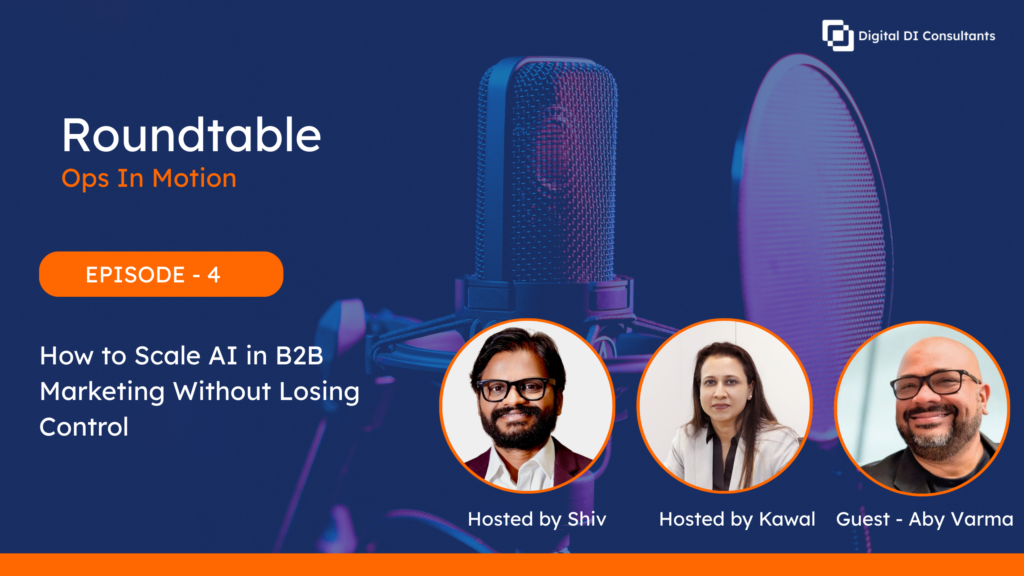
Episode 4
How to Scale AI in B2B Marketing Without Losing Control with Aby Varma
AI adoption in B2B marketing operations requires strategic alignment before technology selection. This roundtable with Aby Varma, founder of Spark Novus and Marketing AI Pulse Community, explores responsible AI implementation frameworks covering three pillars: insights, creativity, and efficiency. Learn how AI enables hyper-personalization at scale, automates CRM data enrichment, reduces campaign bottlenecks, and how to evaluate AI vendors using pilot programs, transparency assessments, and human-in-the-loop governance protocols.

Aby Varma
He is the founder of Spark Novus, an agency that drives marketing transformation through strategic and responsible AI adoption. He also serves as CMO at Shapiro Negotiations and founded the Marketing AI Pulse Community, which has grown to nearly 600 members focused on learning, connecting, and growing in AI marketing.
Transcript
Kawal: Hi.
Kawal: Welcome to the 4th episode of our roundtable series, Ops in Motion.
Kawal: I’m Kawal, a co-founder of Digital DI Consultants, joined by my co-founder Shiv, and we are guiding the conversations on how AI is reshaping B2B marketing.
Kawal: It’s no longer a futuristic concept, but it’s an essential tool for B2B marketing for companies aiming to optimize marketing spend and achieve growth.
Kawal: And in this episode, we are trying to understand the impact of AI on.
Kawal: Marketing operations, sales operations, and B2B marketing in general.
Kawal: And today we have Aby Varma, who has joined us.
Kawal: He’s the founder of Spark Novus. This agency drives marketing transformation through strategic and responsible AI adoption, and he also serves as CMO at Shapiro Negotiations and is the founder of Marketing AI Pulse Community.
Kawal: So happy to have you here, Aby, today.
Kawal: Could you tell us more about yourself and Spark Novas, and the marketing AIPulse community?
Aby: Yeah, no, thank you.
Aby: Firstly, thank you so much for having me.
Aby: Yeah, happy to give a little bit more detail.
Aby: So what Spark Novus does is really we work with, you know, marketing leaders, and often the C-suite to really help them adopt AI strategically and responsibly.
Aby: And what exactly does that mean?
Aby: So in a lot of cases, people focus very much on the technology first, you know, and if you’re looking at the tools and just the market tech portion.
Aby: It’s very easy to get overwhelmed and distracted because there is so much of it.
Aby: And so what we do is really attach their AI initiatives to some sort of a strategic North Star, something that will really move the business and add value at the very top of the business level, and so don’t really start at the technology level.
Aby: So, how do you discover that, what that is, how do you go about it, is what we sort of guide marketing teams to and as far as the marketing AI pulse community is concerned.
Aby: That was, that’s an initiative that we launched about a year ago, and it’s been kind of explosive growth, if you will, because there’s so much interest in AI, as we all know, and the marketing AI pulse community was really started to bring like-minded marketers together who are interested in AI, and we started with.
Aby: Last August and we had like 30 people, and we’re pushing 600 people now in terms of the size of the community.
Aby: So it’s just been phenomenal to see, and the values of the community are kind of learn, connect and grow.
Aby: So we want to make sure that people are learning, they’re connecting, and they’re growing in their careers or whatever it is that they’re seeking.
Aby: That’s a little bit about the community.
Kawal: Nice.
Kawal: Thanks for the.
Kawal: Introduction.
Kawal: I mean, that’s a nice initiative.
Kawal: I’m very curious, and I have another question for you.
Kawal: So, how do you see AI fundamentally reshaping marketing strategy in the next 2 to 3 years down the line?
Kawal: We have seen a lot of changes already.
Kawal: How do you foresee, like, what would be the things that you think would actually change?
Kawal: And I mean, we would love to hear that.
Aby: Yeah, I think the way I answer that is I think what would not change, which is like really.
Aby: This technology is foundational and fundamental to the way marketing is going to function in the future, and in a lot of ways, it is already doing that today.
Aby: So the way I think about it is in sort of threefold.
Aby: So one is, as a result of AI, it’s changing insights, it’s changing creativity, and it’s changing efficiency, right?
Aby: So those are sort of the three broad pillars under which I think about it, but Honestly, every aspect of marketing is going to be touched in some way, shape, form as a result of this, and it’s pretty fascinating to see how people are already dealing with all of these things and, and ultimately I think there’s going to be a time where this is just the way marketing is, you know, going to be done.
Aby: In fact, I was on a call, on a sales call where somebody was pitching me some software, right?
Aby: And.
Aby: In the pitch, they kept saying that Aby, this is SaaS software, and they said it like three times, and I’m like, it’s 2025.
Aby: If it’s not SaaS, what else will it be, right?
Aby: Like you’re not shipping me CD-ROMs at this time, right?
Aby: So, so in a similar fashion, I think we’re going to be at a time with AI where I don’t think we have to announce to the world that hey, we’re using AI in marketing, because just that’s just the way marketing is going to be done.
Aby: It’s already crept into pretty much all foundational, you know, technologies that we’re all using, from Outlook to Salesforce and everything in the middle, it’s already crept in.
Aby: So I think it’s here to say, but the overarching, what does that mean when it comes to you know, insights, creativity and efficiency, that really means allowing marketers to really be more impactful, leverage AI and be more impactful in making sure your company achieves the goals that it set out to do.
Aby: And whether it’s demand generation, whether it’s branding, whether it’s, you know, personalization, whatever your sort of operational goals are, those are certainly going to be much more achievable.
Aby: , and accelerated and creative as a result of it.
Kawal: Great insights.
Kawal: I mean, I have a question for you.
Kawal: You kind of spoke about the three folds or the three pillars of AI that’s being used, right?
Kawal: So, how do you see or how are you currently using AI to really improve the personalization, to a level of improve?
Kawal: the customer service experience as well through AI.
Kawal: So what have you seen that’s been used, and how do you foresee it in the near future as well?
Aby: Yeah, absolutely, great question.
Aby: So that is, I think, the single most significant opportunity, which is becoming table-stakes personalization.
Aby: So before, before AI personalization, everybody.
Aby: Understood the concept of personalization.
Aby: All marketers wanted to do personalization, but the lift of personalization was strong, right?
Aby: You had to have a lot of resources, the right kind of technology to kind of pull it off correctly, right?
Aby: So, but now as a result of.
Aby: So you know, in my fictitious example of personalization, if you were targeting 3 segments and for every segment you have a web page and an email and some social media copy or whatever, so 3 channels and 3 segments, that’s 9 pieces of content that you’ve got to pull off.
Aby: You know, that is considered, quote unquote, personalization.
Aby: Well, obviously, this is a simplistic example, but you can see that the impact of personalization has an exponential sort of impact on the demands of content.
Aby: This is layered on top of the fact that you have a good understanding of who you are personalizing for right now with AI, we’re seeing that your segments can be a segment of one.
Aby: it’s, It could be unique.
Aby: It does not need to be predefined by.
Aby: Human beings, like we are all used to in our databases, you could have AI sort of scan your database, look at behaviors, and kind of make suggestions and what those groups could be, right?
Aby: And those are kind of unique.
Aby: Secondly, making sure that now that you have an understanding of what those segments are and what those groups are, then you can kind of come up with particular custom messages for that group, you know, unique to where they are in the buying stage of the buyer journey.
Aby: So very, very.
Aby: Powerful stuff, and then not only that, you know, you have a better understanding of your customers.
Aby: Obviously, you can write content now as a result of getting that better understanding to serve those customers better, but then also there’s an element of time and place.
Aby: So you want to make sure that you now have an understanding, OK, where is the best place for me to reach these people, and what’s the best time?
Aby: So, something as simple as something we could all do this, like if you, for your listeners and if you guys haven’t tried this, we.
Aby: I’ll post things on LinkedIn.
Aby: You go to LinkedIn, look at your analytics tab, download a CSV, upload that CSV into ChatGPT and ask ChatGPT that, hey, based on my historical posting schedule, and kind of engagement levels, what’s the best time for me to post my content?
Aby: Straightforward, achievable in 5 minutes, and you’ll see that LinkedIn will make recommendations and then you say, hey, now can you correlate the type of content that I post to the time that I posted.
Aby: And give me more insight.
Aby: So, in a very simplistic way, obviously a very simplistic example, but it extends this to kind of an enterprise situation, and it can get really powerful, and there are lots of technologies already out there that will help you kind of do some of these things.
Aby: Yeah, I mean, one of the key things that I feel this all hinges on, obviously.
Aby: The personalization of things on data quality, right?
Aby: So, to me, that is sort of a key aspect of it.
Aby: So let me ask you one thing, Shiv, like you guys do data enrichment for CRMs, right?
Aby: Surely AI, we’re seeing AI is making a lot of impact in that area, but what are you guys seeing?
Shiv: That’s a good one.
Shiv: Now, as you would know, AI in CRM database management is being utilized to automate what was previously manual.
Shiv: Considered as manual work or error-prone tasks, right, such as cleaning up existing databases, filling up the missing details like phone numbers, email addresses, standardizing job titles, or even taking care of duplicates with AI in the picture, this ultimately creates more accurate and comprehensive customer profiles.
Shiv: So let me explain to you with a detailed breakdown of how Automated data cleaning and enrichment kind of takes care of three main tasks.
Shiv: One is error correction.
Shiv: Now, what AI is essentially doing is it can identify and correct the existing data, such as incorrect email addresses or outdated phone numbers.
Shiv: Number 2, it can help you in enhancing the missing data completion.
Shiv: Let’s say you have missing telephone numbers or email addresses, or job titles.
Shiv: Or social media profiles like LinkedIn can add those missing data fields for you.
Shiv: And the third one is data standardization.
Shiv: What AI can essentially do is standardize the data formats, ensuring there’s consistency across the CRM.
Shiv: Historically, about 70 to 80% of the data issues were around these 33 segments of beat error or missing data or data standardization.
Shiv: AI is really changing the game with CRM database management.
Shiv: Now, here’s another thing that we have that we have seen in the recent past is if a lead, let’s say if a lead enters with just a name, an email into a CRM, what AI would do is it, it would, the, the other details that you would need could be firmographic or demographic details or could be like, you know, company details or or the industry name of the industry, or it could be the LinkedIn profile.
Shiv: It can even estimate the company size in terms of employee size.
Shiv: On the revenue size details of the organization within seconds or within no time, and it helps you build a complete profile without really relying on form fields or sales reps to fill in the blanks, which, which is a game changer in a way where in you really do not have to depend on anybody and, and you have the details at your fingertips.
Shiv: It also validates the data regularly, which is very important.
Shiv: In fact, as we all know, data goes bad at a rate of anywhere between 20% to 50% because of various reasons, like people keep changing.
Shiv: Jobs or companies go out of business, or there is a merger and acquisition.
Shiv: Keeping, keeping the database up to date is, is very important wherein the data, database going bad at a very alarming rate, and that’s where AI is again being a big, a big game changer, right, where in it helps you to keep the database clean throughout the year and you can really use it the way you would want for your marketing, sales or customer, program that, that would eventually help you to get you where your organization would want.
Shiv: That’s the thing that we have.
Shiv: In the recent past where AI has been a big game changer for marketing, sales, customer service, and even for the leadership teams.
Aby: And I mean, data quality is sort of the linchpin for successful campaigns in a lot of ways, right?
Shiv: 100%.
Shiv: And these are some of the things that can really be automated within about 5 or 8 years.
Shiv: There was a lot of manual intervention.
Shiv: You had to have people taking care of stuff, and it was time-consuming as well.
Shiv: But thanks to AI, it’s been a big game changer, right?
Shiv: Thank you for sharing that.
Shiv: On the same note.
Shiv: I have a question for Kawal.
Shiv: Kawal, was keen to understand how AI tools are helping you reduce your bottlenecks in campaign operations.
Kawal: Sure, sure, that’s a good question.
Kawal: As we also started thinking about AI use of AI in our day-to-day life, we are seeing that AI is starting to play an impactful role in reducing those bottlenecks that we used to have in campaign operations, right?
Kawal: So, it’s not just taking care of or helping us in content or targeting lists, but it’s also being part of integrations to execution, which is really lovely.
Kawal: Now, here are some of the things I think most of us are taking advantage of AI in our day-to-day lives.
Kawal: And number one would be faster campaign content creation.
Kawal: So AI is saving us a lot of time by creating the initial draft of email, landing page copy, and then suggesting our subject lines and even images.
Kawal: So these creatives are being taken care of, which helps in, you know, reducing the campaign delay, launch delay if there must be, right?
Kawal: So it’s, it’s taking care of those time-sensitive campaigns, and it’s giving us a starting point, an initial draft.
Kawal: To build on, so that’s nice.
Kawal: Earlier, it used to be like everyone, the person who is taking care of this campaign has to spend a lot of time understanding, creating those initial drafts, and there are going to be a lot of iterations, but AI is giving us those, so that’s really been cool.
Kawal: And the second one is segmentation and audience for QA.
Kawal: So, AI is helping us validate and clean up those audience lists.
Kawal: Now it’s also helping us out, highlighting the incomplete records, deduplicate records, and it’s highlighting the list.
Kawal: Projects like if there’s a missing suppression list or you know, reviewing the nurture list to remove contacts who should not be part of those nurture campaigns.
Kawal: Now this helps us in validating the enrichment of fields before the campaign launch, which is good because the target audience is really important for a campaign launch and for a campaign to be successful.
Kawal: Now, personalization is also essential.
Kawal: I think we spoke about it, before 5 minutes, right?
Kawal: So, personalization helps us to require or tailor the message according to, you know, personas or industries.
Kawal: Verticals now, AI is generating those dynamic content blocks that adapt based on the firmographic or behavioural logics.
Kawal: Now this saves our time in cloning those campaigns, the number of times and then launching them.
Kawal: So we can create one initial draft, and we would, you know, prompt AI to create those different variations, and AI would take care of that.
Kawal: So, it’s useful for ABM and nurture flows again.
Kawal: The fourth one is the workflow QA logic suggestions.
Kawal: So, some of the flows or the tools are being used.
Kawal: AI to review automations and suggest if there are missing conditions or if we have any broken triggers that are being highlighted by AI, or if there’s any conflict before the campaign is launched or the workflow is active.
Kawal: So, this has reduced QA time and also taken care of human errors, which is good because we are away from the manual work that we used to do earlier.
Kawal: Now integration monitoring and sync.
Kawal: So, integration is often causing some sync issues between the tools, like some of the lead details or some of the fields that are not syncing.
Kawal: One tool to another.
Kawal: So, using AI-driven monitoring helps us catch those sync errors, field mismatches, or API failures before they affect any live campaign, which is again useful because, otherwise, sitting down and looking at each detail is really time-consuming.
Kawal: And our real-time data sync, the AI entries are incomplete records by pulling in firmographic data or job titles or a social link without having to create those gated forms.
Kawal: So, earlier, we used to create gated forms for most of the activities.
Kawal: Track more information, but then AI is helping us, keeping that short, and we don’t have to have gated forms everywhere.
Kawal: That used to be annoying for most of us, but we had to do that.
Kawal: After the campaign is launched, we have reporting and insights.
Kawal: So AI tool helps us in summarizing the performances.
Kawal: It’s highlighting the key trends and audience drop-off, if there are any conversion blockers.
Kawal: So that means we can review them and make changes without having to spend, you know, hours on connecting those spreadsheets.
Kawal: Sheets connecting different tools and spending hours on reports and dashboards, which is really a relief.
Kawal: Now I would say that AI isn’t replacing humans in marketing operations, but it is helping us to move faster, reduce errors, and focus on strategizing things.
Kawal: The less time we spend on a cleanup and manual QA, the more time we have to optimize what we are actually doing, and that helps drive a better pipeline.
Kawal: So, having said that, you know, we spoke a lot about how important AI is in our day-to-day life.
Kawal: Aby, you are the founder of Spark Novas, an agency that is driving marketing transformation through strategic and responsible AI adoption.
Kawal: I have a question for you.
Kawal: So, how do you vet or evaluate an AI vendor or a tool before adoption?
Kawal: Do you have any suggestions for best practices?
Kawal: Because it’s essential.
Kawal: Once you’re adopting something, you have to make sure that things are working fine.
Kawal: Again, if it’s not, I mean, that’s, that’s again a dead end, right?
Kawal: Over to you, Aby.
Aby: Yeah, no, great question.
Aby: I think first off, I always advise teams to look inwards in terms of establishing what the business needs for that, right?
Aby: So like I said at the top of the show, you know, teams often just dive in headfirst and start with technology, and I recommend not to do that, as sort of counterintuitive as it may seem, right?
Aby: So my first advice, and it’s not uncommon for us, we’ll do workshops, and we’ll come up with use cases and everything, when we’re working with marketing leaders, we’ll discover 40, 50 use cases in half.
Aby: Day workshop, like they’re excited about it and everything.
Aby: Well, that’s a lot, right?
Aby: For each use case, you can have the top 3 to 5 technologies that are there because this tech the Martech space is exploding, as we all know.
Aby: The first, sort of idea is look inwards and do some prioritization and focus on those tools and technologies that are adding business value and that are aligned to your business goals, not saying that the other use cases are not important, but it is relative importance, right?
Aby: an example is.
Aby: One of our clients had, you know, they were thinking of AI as a use case for kind of re-tagging all the millions of assets that they had in their digital asset management system.
Aby: Great use case, tailor-made for AI in a way, in a lot of ways.
Aby: Another example was that they were entering a new market, and they wanted AI to do some pipeline development.
Aby: And cold outreach and those sorts of things, right?
Aby: Another great use case, but I can tell you in terms of business value, when they were having internal discussions, which is the one that got funding, is the second one, right?
Aby: Not that the first one was not important, but in terms of relative importance, the second one was going to add business value, was gone, you know, impact sales and those sorts of things.
Aby: So I think.
Aby: I think aligning has some sort of an internal cycle to determine what what’s the technology is and then aligning your technology choices or use case choices to things that add business value.
Aby: All right, so that’s step one.
Aby: Then after you’ve done that, it comes to, you know, deciding the right technology, picking the right vendor, and those sorts of things, right?
Aby: and that is, Super, super important and complicated these days in so many different ways, right?
Aby: Because there is a lot of quote-unquote AI washing that is happening, right?
Aby: Like, where these technology providers because people are just throwing in, yes, AI-powered and when you actually start understanding it, there’s one minor.
Aby: You know, a feature that has almost nothing to do with the overall functionality of the tool.
Aby: There’s some AI; they’ve checked a box somewhere that AI is being used.
Aby: So, my first sort of best practice is, regardless of whatever the tool is, I always advise that, hey, you’ve got to try it and prove it before you scale it.
Aby: So if you have a marketing team of, you know, 20 people, 30 people, whatever, a big marketing team.
Aby: Then, before you commit to that piece of technology, to the whole team, make sure that you can experiment, try it and prove it, prove the value in a short period of time with a more minor team.
Aby: Do a one-month pilot and try it out, and if it succeeds, scale.
Aby: If it doesn’t succeed and that pilot failed, great, move on.
Aby: My only advice is fail fast, so you have an understanding, you know, what the technology is.
Aby: Does or does not do.
Aby: So that is sort of key.
Aby: The second thing is sort of transparency, making sure you are evaluating the transparency from the vendor standpoint, right?
Aby: So, all vendors talk about publicly is the value of the AI, but how is the data being used?
Aby: What are the outcomes being generated?
Aby: How data handling is happening behind the scenes is not going to be in the marketing material.
Aby: That is going to be in their MSA legal language fine print, right?
Aby: To make sure that you’re involving your legal people and getting an understanding of how are they using your data, how are they, where is, how have they trained AI, what, what sort of protocols they have in place from a security and safety standpoint, so super critical like soc to compliance and all those things for bigger enterprise companies.
Aby: So super important to really evaluate the.
Aby: And really take time to look at the fine print, and marketers should not do this alone, should work alongside IT and legal and compliance folks within your organizations to certainly do that.
Aby: But the third thing is the, you know, human in the loop.
Aby: So, to me, I think the buck stops with human beings, and I think we all know AI hallucinates and makes things up and, you know, there’s bias and all those sorts of things.
Aby: So, make sure that what?
Aby: Whatever is the outcome of the tool that you’re using, there is an excellent understanding of how AI is making decisions and what the output is and the fact that you have control where humans can change the output, right?
Aby: So there have been times when you may have, we’ve come across technologies where it’s sort of.
Aby: that’s a, it’s a black box, right?
Aby: You put stuff in, you get in, get the AI output, and then, you know, it gets pushed out live or whatever, and there’s no control for humans to be in the loop and override the AI outcome.
Aby: So that to me is undoubtedly a red flag, and then more importantly, getting an understanding of how AI is making those decisions.
Aby: For example, we’re looking at some paid media technologies where AI is deciding.
Aby: You know, how much money to move from Google to Meta, for example, or within a campaign on a particular platform.
Aby: Well, you gotta make sure that you have a substantial understanding of how AI is making those decisions, right?
Aby: That and then finally I would say, kind of two things obviously, insights, making sure that whatever is the tool of choice, it’ll give you analytics and KPIs on how AI is moving the needle on the expected impact, so.
Aby: You know, for example, content is a low-hanging fruit for a lot of marketing teams where they want AI to generate more content.
Aby: Well, more content is not the KPI.
Aby: More content is just the outcome.
Aby: It’s like, what is the impact of that content?
Aby: Are you getting, you know, is it more SEO optimized?
Aby: Are you getting more organic traffic?
Aby: Although we could do an entirely new episode on the impact of AI on SEO, and then, like, lead generation.
Aby: So if you have content that is being created to identify the impact, not just the activity of what the AI is going to do and make sure you have.
Aby: KPIs to track that, right?
Aby: Otherwise, you will be tracking only tactical things and then like finally, if you zoom out, making sure that whatever your technology is fits into your overall tech stack ecosystem, right?
Aby: So there isn’t in the world of Martech, if you, if you guys follow Scott Brinker’s, you know, Martech, yeah, volume, there’s so many pieces there’s like 13, 15,000.
Aby: I don’t remember the last number he had, the report that came.
Aby: Out in May, there’s like crazy volume of Martech technologies out there.
Aby: So gone are the days when all your Martech is going to fit in neatly in boxes, and there’s no overlap.
Aby: There are all kinds of overlap.
Aby: So, so I think the marketing teams that strive for clean overlap that, hey, I’m going to use this tech for this function and that tech for that function, and there’s not going to be an overlap.
Aby: I think that’s a slippery slope.
Aby: I wouldn’t kind of waste time, but what I would do is make sure the right tool for the right purpose and have it.
Aby: Internal governance rules that hey, we’re going to use tool A to do this and we’re going to use tool B to do something else, even though tool B may there may be a little bit of overlap with tool A, but tool B is the primary tool that’s the bread and butter of that functionality.
Aby: So, making sure that you have an understanding of what that looks like and AI in a lot of ways is changing that as well, because the lines are blurring because it’s not so much linear anymore.
Aby: So the world of AI is sort of getting.
Aby: Blurry, and those lines are getting blurry.
Aby: I know that was a lot, but I wanted to share how we approach it.
Shiv: Yeah.
Shiv: I love that.
Shiv: I mean, the three takeaways from me, at least for, from the, the last thing that you just explained, there was one is fail fast.
Shiv: I think it’s essential to fail fast and recover and get moving.
Shiv: The second one was to try to prove it, to scale it.
Shiv: Very well said.
Shiv: I mean, that’s where many of the organizations or teams kind of fumbled.
Shiv: And the third and the most important was.
Shiv: The buck stops at human beings.
Shiv: You would want to know what kind of KPIs, what kind of things you would want the AI to do.
Shiv: AI is doing, doing whatever it’s doing is one aspect, but you’re having control over it.
Shiv: The example that you gave, right?
Shiv: I know what kind of budgeting you would want to shift from, let’s say, meta to Google and the other ones, right?
Shiv: So, having control over it is an important aspect.
Shiv: Amazing, I mean, I mean, great having you.
Shiv: We are wrapping up another insightful episode of Roundtable Ops in motion this in this one.
Shiv: Explore the evolving role of AI in B2B marketing from strategic planning to hyper-personalization to CRM database management, and then, of course, the marketing automation part of AI.
Shiv: It’s clear that AI is no longer a future concept, but it’s actively shaping how we operate today.
Shiv: Thank you, Aby, for your time.
Shiv: We had a great time chatting with you, and of course, thank you, Kawal, for your time.
Kawal: Thank you for having me.
Kawal: Thank you.
Aby: All right, have a good one, guys.
Aby: Thank you.