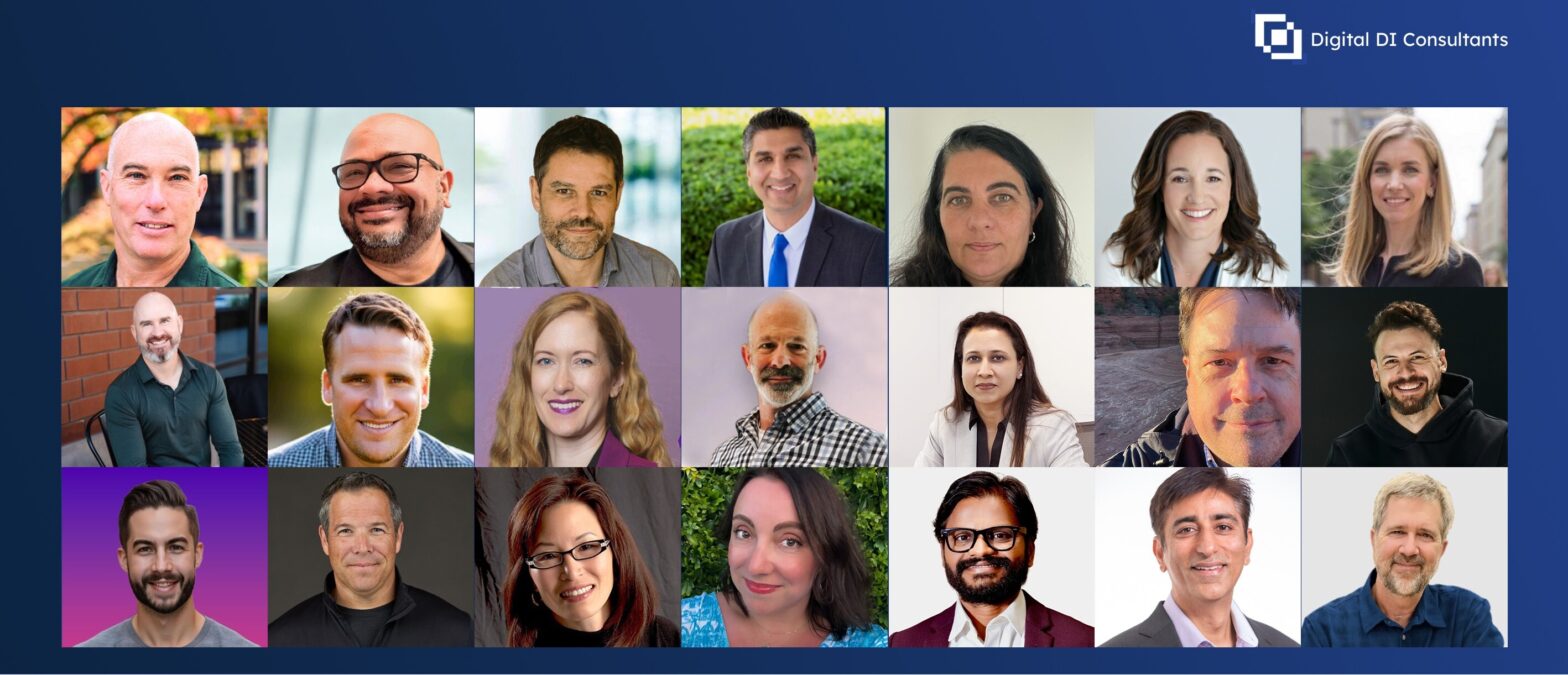
Expert voice from the top 21 B2B Marketing and Sales Leaders:
AI’s Impact on B2B Marketing in 2026, a survey by Digital DI Consultants
B2B marketing is evolving faster than ever. In just the past six months, AI has shifted from a supporting tool to a central force shaping decisions, customer insight, and how marketing teams operate.
At Digital DI Consultants, we’re seeing this change play out in real time. Client conversations have moved beyond efficiency and automation toward a more pressing question: are marketing teams building the skills they’ll need for the future?
So we asked 21 marketing and sales leaders a simple question: How will AI shape B2B marketing in 2026, and what skills will define successful marketers?
Here’s what they had to say…

By 2026, AI will be embedded across every layer of the go-to-market engine from demand generation to pipeline management and forecasting. The real advantage won’t come from adopting AI tools faster, but from leaders who design clean data, clear ownership, and disciplined processes that enable AI to deliver reliable insights and measurable impact. AI will scale with whatever exists today; strong foundations will scale growth, weak foundations will scale chaos.
AI will expose broken processes, poor data quality, and disconnected GTM teams faster than ever before. Teams that treat AI as a bolt-on productivity tool will struggle. Teams that treat it as a systems accelerator will win.
The biggest shift is that marketing will no longer be judged by activity—it will be judged by operational clarity and business outcomes. AI doesn’t tolerate ambiguity. If your inputs are messy, your outputs will be too.
In short: AI rewards teams that slow down, design properly, and treat their GTM motion like a product.


AI thinking skills, the new workplace literacy of knowing how to collaborate with AI, structure problems for AI, evaluate outputs from AI, and integrate AI into workflows responsibly.
It’s not technical. It’s not coding. It’s not prompt engineering.
It’s the human skill of thinking in ways that make AI amplify your capabilities rather than replace them.
I think communication skills, such as change management, will be more important as actual necessary changes and also unnecessary requested changes from executives and others in the company about “the next big thing” seem to be arriving at a faster and faster pace. Marketing has been a difficult job for a while, as every person in the company who uses personal social media gives advice or requests to the marketing department, since they see marketing every day in their lives. Marketers will hopefully remember that they and their teams are humans, talking to humans as customers, after 2025 was overhyping AI as the solution to every problem.


AI will finally make personalization and execution at scale real. As machines take over the manual grind, B2B marketing shifts from execution heavy to decision driven. Strategy stays human. The busywork doesn’t. That said, getting there will take real work in data , processes & mindset.
AI is inescapable at this point. Even if the value proposition isn’t there yet in every case, the fear of missing out or being a late adopter seems to be driving a lot of businesses to adopt AI. Marketing Ops teams are the best positioned to help their own companies or clients with these implementations because of their systems mindset and their ability to grasp the importance of data.


In 2026 and beyond, AI becomes the operating backbone of B2B marketing. It expands capacity, sharpens decision making, and turns signal into action faster across the funnel. But technology is not the differentiator. Leadership is. The CMOs who succeed will be the ones who govern AI with discipline, protect brand trust, and stay accountable for real business outcomes.
AI makes average marketing easier and great marketing harder. When everyone can generate content at scale, originality, insight, and genuine customer understanding become the only real advantages left.


The skills successful marketers need now and in the near future are actually the same as what has always made them successful – embracing change, thinking of new ways to adopt technology, and being customer focused. AI is absolutely a tool that marketers must adopt but don’t let ‘AI’ distract you from the value you as a marketer bring to the organization with your core marketing skills and approach.
AI will widen the gap between experienced and entry-level specialists, making experienced marketers more effective, allowing them to be involved in multiple programs at the highest level, while entry-level marketers will over-rely on AI, not allowing them to get the experience needed to develop a good marketing taste. This will create a chasm between marketing campaigns that actually work and the vast sea of mediocre marketing that has zero engagement.


B2B is challenged with scaling AI across cross-functional teams. While individual contributors use AI a lot for content creation, teams struggle to operationalize uniform use of AI especially in marketing analytics- where the trust to probabilistic LLM- based AI outputs – based on lack of business rule-driven guardrails, data structures and security concerns – and sharply declining.
Don’t be scared of AI, embrace it, it’s everywhere. Learn how to work with it and you will become so much more efficient.


Context switching. Knowing which AI tools to try, when to abandon them, and how to move fluidly across models without mistaking experimentation for progress.
The impact will be felt mainly in the creation of velocity but I believe we will also have as many fails as successes where people try to overreach with the current capabilities.


The real challenge and opportunity will be when the B2B marketing leaders treat AI as a leadership and operating decision, not just an experiment. It’s important to balance speed, accountability, and innovation to achieve predictable business outcomes.
AI will continue to have an evolving impact in 2026 — AI and its application to b2b is in flux. Teams are still figuring out how to use AI for the benefit of sales and marketing efficiency in b2b all while figuring out if they can trust the results that AI produces. For B2B teams that do lean into AI in 2026, I think we will see the largest advancements in vibe coding to create small internal applications to make teams more efficient, creation of “gems” or “custom GPTs” tuned to the company’s main customer personas for asking questions to in order to generate customer targeting insights from them, and AI used to create on brand content faster.


I view 2026 as the year marketing stops celebrating volume metrics and starts being held accountable for decision impact. My approach to the future of AI is grounded in four realities:
- Infrastructure, not features: AI becomes the connective tissue for GTM, not just a content generator.
- Signal over noise: The goal is better prioritization and intent, not infinite reach.
- Trust as the moat: As buyers get skeptical of black-box algorithms, explainability and governance become our biggest competitive advantages.
- Human taste reigns supreme: AI can reveal patterns we can’t see, but it cannot replace the emotional intelligence required to connect with a human buyer.
Tools are leverage. They’re all about multiplying human capability and capacity. In 2026, AI will test the quality of our Logic and our ability to understand what is Real and what is not. It will be important to know how to get the most from AI, but knowing how to think is the skill that AI magnifies most.


I’m optimistic that we will be more tailored in the experiences that we create for our potential customers and current customers. The speed of evolution of the tools will support better design. Design for customer experience – both current and future, and internal and external will be improved.
AI skills are definitely going to be differentiators in the marketplace for marketers in 2026 and beyond. If you aren’t starting to brush up on your AI skills, you should start this year. It could be the difference between getting the job, and not getting the job.


AI presents an opportunity for marketing, as it promises to unlock productivity and enable marketers to focus on the activities that are in marketers’ core value proposition. It also presents a temptation for cost-restrained to automate activities that require human intuition and creativity. Marketing’s challenge in this environment is to use wisdom to determine how to operate in a way that enables the organization and employees to thrive.