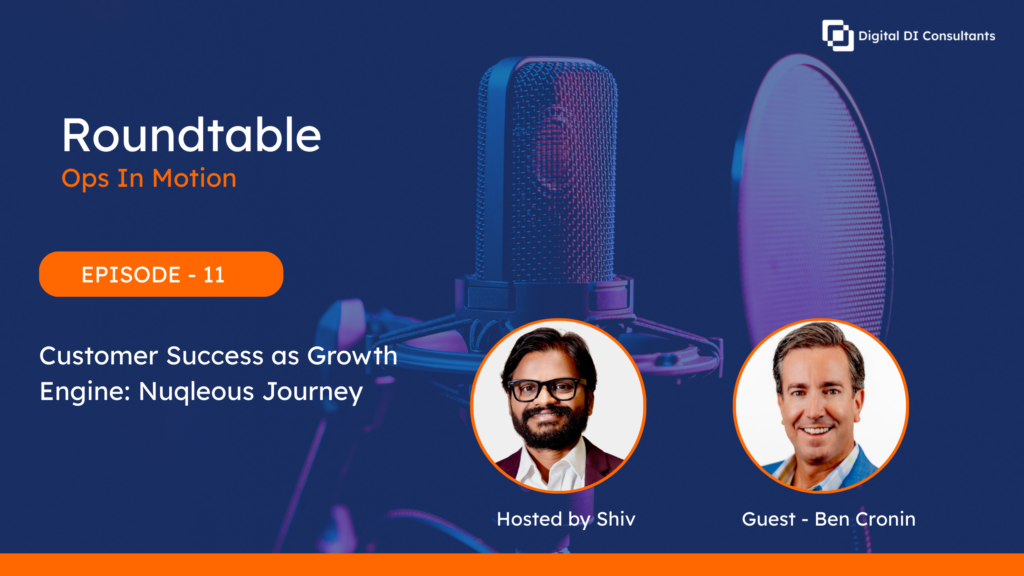
Episode 11
Customer Success as Growth Engine: Nuqleous Journey with Ben Cronin

Ben Cronin
He is the CEO at Nuqleous with almost two decades of experience serving in the CPG and retail space. Under his leadership, Nucleus has been on the Inc. 5000 list for 5 straight years. The company provides solutions for planogram execution, retail analytics, and dynamic presentation tools (Shelf IQ, Retail Analytics, and Present IQ) to help CPG and retail customers optimize operations and drive growth.
What Five Years on the Inc. 5000 List Actually Takes With Ben Cronin
Introduction
Nuqleous has landed on the Inc. 5000 list five years running, a growth benchmark that reflects deliberate strategy rather than chance. Ben Cronin, CEO at Nuqleous, joined this episode of Ops in Motion to talk through what’s actually behind that streak: solving specific, painful problems for CPG and retail customers, marketing to a sales-minded buyer in a way that fits how they actually work, and treating customer relationships as a strategic investment instead of a support cost.
Who should read this: marketing and customer success leaders looking for a concrete example of what product-market fit and customer investment look like in practice, particularly in B2B categories with sales-driven buyers.
Key takeaways
- Nuqleous built its growth around three specific, named problems its customers deal with every day, not a broad platform pitch. That specificity is a big part of what product-market fit actually looks like.
- For sales-minded buyers, face-to-face touch (events, meetups, even a company pickleball tournament) has outperformed purely digital marketing.
- Account-based marketing works best when it starts with which personas inside an account actually need which tool, not a generic list of target accounts.
- Investing in strategic customer relationships, not just transactional support, takes time to show up in customer feedback, but it compounds.
Product-market fit looks like solving three specific, named problems
Ben’s account of what’s driving growth at Nuqleous is unusually specific for a company profile. Rather than describing a broad platform, he named three exact problems CPG and retail customers face every day. Planogram execution, adjusting store floor plans for new seasons or shifting shopper behavior, is often slow and stuck on rigid, outdated tools. Forecasting is buried under a growing volume of point-of-sale and market data that teams don’t have the bandwidth to fully use. And building the buyer presentations CPGs need to pitch retailers, often 40 to 80 pages of highly specific data, can eat hundreds of hours per pitch.
Each Nuqleous product maps directly to one of those problems: Shelf IQ automates planogram optimization, Retail Analytics turns raw data into where a brand is winning or losing share, and Present IQ generates dynamic, presentation-ready decks in minutes instead of the days a team used to spend building them by hand.
The lesson worth pulling out of this isn’t about CPG software specifically. It’s that product-market fit tends to show up when a company can name the exact problem it solves in one sentence, not when it can describe everything its platform is capable of.
“Product-market fit is when the tools or solutions you provide are generating tremendous value for customers, and customers want, if not need, those tools to operate and win at their job every single day.”
— Ben Cronin
Face-to-face marketing still outperforms digital when your buyer is sales-minded
Nuqleous sells into commercial teams, people who are naturally oriented around relationships and brand themselves. Ben’s team has found that face-to-face touch consistently outperforms other channels with that audience: hosting events at their own locations, showing up at Category Management Association meetings, and running an annual pickleball tournament that gets even direct competitors in the same room together.
The value isn’t just goodwill. Getting people from across an industry into a room, even competitors, creates real conversations about what’s actually happening in the business, which is harder to replicate through a webinar or an email sequence.
Nuqleous is also leaning further into account-based marketing, but with a specific correction: even with premier brand customers, not every team or tool inside those accounts is being fully used. The focus now is on getting precise about which personas within an account actually need which capability, rather than treating ABM as a broader version of the same generic messaging.
Shiv, the episode’s host, added three predictions for where this is heading through 2026: unified, one-to-one customer experiences stitched together across channels rather than siloed by channel, AI enabling personalized content and service at a scale that wasn’t previously possible, and using ICP data to prioritize which interactions actually matter instead of treating every touchpoint as equally important.
Strategic customer investment takes time to show up, but it compounds
Nuqleous recently elevated two leaders, Jenny and Dan Gallagher, into customer management roles, a direct response to feedback gathered during due diligence and customer conversations. The consistent theme customers raised wasn’t about the product. It was that the relationship with Nuqleous felt more transactional, closer to support, than strategic.
That became one of the company’s core investment priorities. At a recent customer advisory board meeting, customers reported starting to feel the shift, evidence that the leadership change was translating into a genuinely different relationship, not just a new title on an org chart. Ben was candid that there’s always a lag between making an investment like this and customers actually feeling its effect, and that lag is worth planning for rather than expecting instant results.
Action items
If you’re trying to articulate product-market fit, name the specific, recurring problems your product solves rather than describing your platform broadly.
For sales-oriented or relationship-driven buyers, test whether in-person touchpoints (events, meetups, informal gatherings) outperform digital-only channels before assuming digital is sufficient.
Before scaling an ABM program, map which specific personas inside target accounts need which capability, rather than applying uniform messaging across the account.
If you’re investing in strategic customer relationships, set expectations internally that customer sentiment will lag the investment. Measure it over a full cycle, not the first quarter.
FAQs
What does product-market fit actually look like in practice?
It shows up when a company can name the specific, recurring problems it solves for customers rather than describing its platform in general terms. Customers should feel they need the solution to do their job well, not simply find it useful.
Does face-to-face marketing still work in B2B?
For sales-oriented buyers in particular, yes. In-person events, industry meetups, and informal gatherings can outperform purely digital channels because they create real conversations that a webinar or email sequence can’t replicate.
How long does it take for a customer success investment to show measurable results?
There’s typically a lag between making a leadership or team investment and customers actually feeling the difference. Gathering structured feedback, such as through a customer advisory board, is one way to track when that shift becomes real.
Talk to Digital DI Consultants
If you’re trying to sharpen how you talk about product-market fit or build a customer engagement strategy that goes beyond transactional support, talk to our team about your setup.