Digital DI Consultants

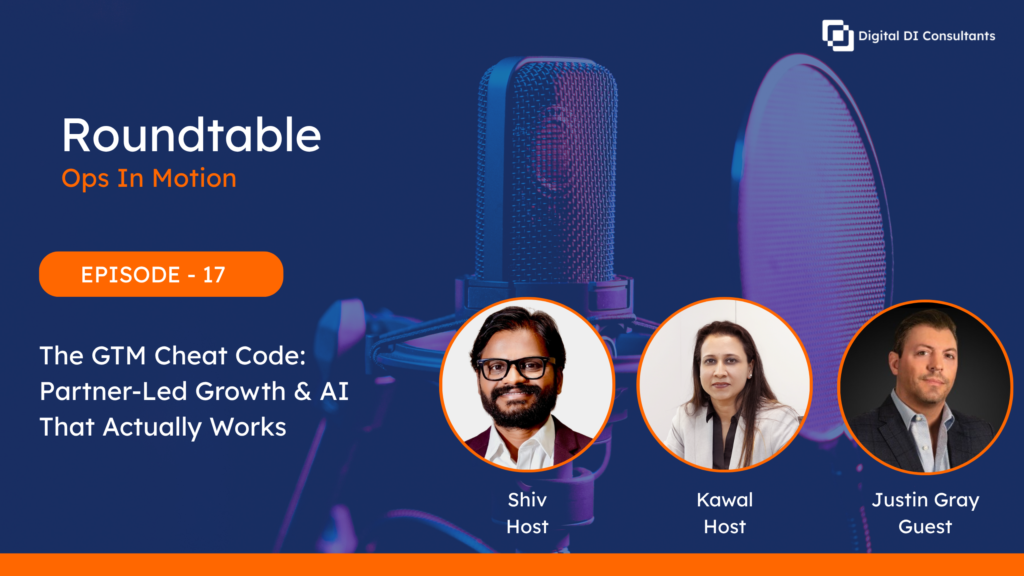
The GTM Cheat Code: Partner-Led Growth & <br/> AI That Actually Work With Justin Gray
Episode 17

The GTM Cheat Code: Partner-Led Growth &
AI That Actually Work With Justin Gray

Most B2B go-to-market teams adopt AI tool by tool, with no organization-wide strategy connecting marketing, sales, and customer success. Justin Gray — who founded and exited LeadMD after 6,000+ Marketo implementations — explains where AI creates real GTM value today, why data quality determines whether AI outputs are useful or misleading, and how partner-led growth consistently outperforms cold outreach for B2B revenue teams.

guest-role

Justin Gray

He is a serial entrepreneur and operator who founded and successfully exited Lead MD, a leading marketing and revenue operations consulting firm with 64 employees. He is now co-founder of In Revenue Capital, which invests in seed to early-stage companies and takes an “operator immersive” approach, providing hands-on go-to-market guidance alongside founders. He is also the author of “Go to Market Cheat Code: The Secret to Unlock B2B Growth.

Transcript

Shiv: Hello, everyone, and welcome to another episode of Roundtable Ops in Motion. I’m Shiv, co-founder and CEO of Digital DI Consultants, joined by my co-founder, Kawal. As always, we are very excited to bring you conversations with leaders who have built, scaled, and transformed businesses and shared their experiences with our community.

Shiv: Today, we are delighted to be joined by Justin Gray. Justin is a serial entrepreneur, operator, investor, and a well-known name in the B2B GTM space.

Shiv: Over the years, he has founded and successfully exited multiple companies, including Lead MD, one of the most respected consulting firms in the marketing and revenue operations world.

Shiv: What makes Justin’s perspective particularly valuable is his belief that most startups don’t struggle with the what or the why, they struggle with the how and the who.

Shiv: Today, through InRevenue Capital, he combines his GTM expertise with investment to help founders build, scale, and execute more efficiently.

Shiv: Justin, we are thrilled to have you with us. Welcome to Ops in Motion.

Justin: Hey, nice to meet you both, and thanks for having me.

Shiv: Absolutely, thank you so much, Justin. Would you like to tell us a bit more about yourself and your journey?

Justin: Well, I mean, you definitely listed the highlights there. I’m a serial entrepreneur and operator, it’s what I love to do.

Justin: I love the one-to-ten journeys specifically, and that’s what InRevenue is ultimately focused on.

Justin: We call those seed and early-A investments.

Justin: We don’t lead investments; we’re always syndicating, meaning our go-to-market channel is our partners.

Justin: That’s the same principle I’ve built every business on, partner-led growth, partner ecosystems, and partner companies.

Justin: So, VC organizations that share our thesis and our focus, and that we like, will bring us deal flow.

Justin: We evaluate those deals and do a maximum of three to four deals per year.

Justin: We just closed our second for 2026, so we’re on pace to do that again this year.

Justin: When we invest and we write checks between $1 million and $3 million we also step in from a go-to-market perspective in a very hands-on manner.

Justin: As you mentioned, a lot of VCs come to market with a value-add, and I think anyone who doesn’t add some sort of value is at a great disadvantage in today’s environment and market.

Justin: However, we go a step beyond that normal value-add.

Justin: Yes, we’ll advise, we’ll share experience, we’ll share our expertise, but we’ll also get in, roll up our sleeves, and operate right alongside the founders and their teams at the companies we invest in.

Justin: That tends to be our unique special sauce we call it ‘operator-immersive.’

Kawal: Wonderful. That’s quite impressive, Justin. I’ve been personally following you for quite some time.

Kawal: Maybe we can take a step back, I’d like to understand your experience running Lead MD, and maybe talk a little about the exit as well. Then we can move on from there.

Justin: Sure. Lead MD was my latest go-around.

Justin: I’ve done software, payments, and services in my career, but I never had any prior experience in any of those areas before getting into them.

Justin: I got into software in 2006, in the very early days of SaaS, and learned about it.

Justin: I helped build a business there and exited through sweat equity, then used that sweat equity to start a host of other businesses, Lead MD being one of them.

Justin: I talk about Lead MD so much not just because of recency bias, but because it was a business based on people which was a first for me.

Justin: Before that, it was software, payments, and product or solution selling and you could make the same argument for consulting.

Justin: But that product walks out of your office every day on two legs.

Justin: And if you want the hardest position at the hardest type of organization in the world, I firmly believe you should go work for a consultancy, because the only reward for being great at your job is more work.

Justin: Your A-players tend to get saddled with not only the responsibility but a lot of the day-to-day execution, and that was certainly true at Lead MD.

Justin: I think about a year in the business was originally founded in 2011, based on a market need.

Justin: Marketing automation was just building as a wave at that point.

Justin: Marketo and Eloqua were going head-to-head; there were a number of incumbent and up-and-coming providers, and it was an interesting time.

Justin: People wanted the new technology but had no idea how to use it.

Justin: Things like automated lead flow, lifecycle scoring, and nurture were all brand-new concepts, brand-new words, so they needed support to do it.

Justin: It was that organic response that ultimately birthed the business, and about a year in we had around $7,500 in revenue, most of it recurring, since we started off as a retainer-based business.

“The greatest company asset is its people.”
LeadMD distributed 50% of its exit value to employees through phantom equity.

Justin: But as you start hiring employees, every business owner has a moment where they look around and ask, ‘What do I want this business to become?’

Justin: Rarely do we have that foresight right when we start a business, because we’re often reacting to demand or at least I think the best businesses are.

Justin: As I started to look around, it dawned on me these people were working really hard, and there was no path in sight to reducing that workload.

Justin: If anything, it would only increase.

Justin: So, I started to contemplate, and ultimately build, what I think was the fundamental value we provided in that business: phantom equity.

Justin: Fast-forwarding to the exit, 50% of that exit value went to my employees.

Justin: That was a principle we started very early on: if you give me your hard work probably more than you’d give any other employer I will reward you with equity, and I’ll build that equity over time.

Justin: Everyone who was hired had an initial grant, and as they moved up in responsibility or role, we granted them more units.

Justin: It wasn’t a traditional stock-option plan; it was more of a phantom-equity or change-of-control bonus program.

Justin: You can look those up on Claude, ChatGPT, or whatever you’re using but effectively, it’s a way to grant equity in an organization without incurring a tax liability at the time of the grant.

Justin: There’s no option, and there’s no cliff the ultimate cliff is the liquidity event, which I loved because it kept everyone focused on the same goal.

Justin: My goal was certainly to exit that business.

Justin: I didn’t see myself running a consultancy for the next 40 years of my life, but I felt it was an interesting market opportunity because the market was evolving so fast not unlike today.

Justin: New technologies were emerging, and people needed guidance in that area, but they also just needed guidance as marketers and demand generators engaging their buyers, because there were so many new avenues and ways to do so.

Justin: The web was becoming a thing, social was becoming a thing, mobile was there all these new pathways, and we were coming from a very archaic way of communicating with our buyers.

Justin: As that grew, we knew we needed to grow our team, and by the time we exited we had 64 employees.

Justin: A lot of those people had been there a long time one had been there ten years, and I was there for the entire eleven-year lifecycle of the business.

Justin: So we built an effective magnet with the promise that you could come to Lead MD and work on things you wouldn’t have the opportunity to work on anywhere else, because we expanded over time starting in marketing automation and expanding into the whole of marketing: strategy, brand, market research, data science (what we now call AI), go-to-market strategy, and other technologies beyond marketing automation, like CDPs and data warehouses.

Justin: We covered probably 85–90% of what a marketer does.

Justin: The only area we intentionally stayed away from was paid acquisition.

Justin: We gave people paths to learning we called them ‘tours of duty.’

Justin: You could come on for a two-year tour of duty, which was our minimum.

Justin: What are you going to achieve in the next two years?

Justin: What do you want to learn?

Justin: What does the next step look like?

Justin: We really challenged people to think about their careers that way.

Justin: At the end of the two years, we’d decide whether to renew that tour of duty are you enjoying it, do you see this as a unique opportunity, or is your next step something we can’t provide here?

Justin: One woman we hired wanted to become a nurse a big career change for her, since she’d been in marketing her entire career.

Justin: So we gave her the opportunity to learn some practices and go to school at night to prepare for that journey, and she ended up staying far beyond the initial two years.

Justin: Looking at it through that lens the grant of equity I think we developed a very unique environment.

Justin: We definitely developed a sense of family and camaraderie there, even though I hate to say it because it’s overused.

Justin: Since we ultimately sold to private equity, I’ve had conversations with probably 75% of the organization who’ve told me that was truly unique, and they wish they’d recognized how unique it was at the time hindsight is 20/20.

Justin: And frankly, I’d say the same thing.

Justin: So, that’s a long diatribe, but that’s the journey of Lead MD.

Justin: We exited at the height of the market I could say that was intentional, but really it was the bit of luck every founder will tell you they need.

Justin: It was a great opportunity for me, my employees, and certainly my family, so I look back on it with fondness and as a real success.

Kawal: Wonderful. Congratulations.

Shiv: It feels so nice, Justin, hearing you talk about LeadMD and the kind of programs and initiatives you built for your employees.

Shiv: I can just imagine the employees went through a great experience, one that will stay with them forever.

Shiv: That’s really nice.

Justin: A lot of those people have gone on to start their own businesses, which I think is the greatest testament to that environment and opportunity.

Justin: That, to me, is the real pinnacle of success if you can bolster people’s confidence and give them the experience they need, they’ll feel like they can go out and hang their own shingle.

Justin: So yeah, I think it was unique.

Shiv: Yeah the other day, Kawal and I were talking about this, and I saw your post as well, about identifying your A-players and backing them.

Shiv: Not to be cliché, but forming a team that feels like a family, giving your all eventually it’s a win-win for everybody.

Shiv: I couldn’t agree more.

Justin: Yeah, agreed.

Shiv: Moving on, Justin we’ve moved beyond the AI hype cycle at this point, I hope.

Shiv: From what you’re seeing today, where is AI genuinely creating value inside GTM teams, and where is it still falling short?

Shiv: Those are the two things we’re curious about where the value is, and where it’s really falling short.

Justin: Yeah, so just to comment briefly on the AI maturity curve and where we’re at I don’t think anyone can truly say, because we don’t know what the end of that curve looks like.

Justin: Just like we didn’t with things like the web, or Web 2.0, or however you want to phrase it — things are always evolving; that’s my point.

Justin: But at the point we’re at today, the potential is there to create real value by leveraging the tools in the market.

Justin: We actually did a study on this if you go to our website, inrevenue.com, under our Insights section, you’ll find what we call ‘Cheat Codes.’

Justin: We did a pretty in-depth market study, both within our portfolio and the broader market a couple of roundtables, a lot of feedback gathered really studying the use cases where AI is having an impact in GTM.

Justin: It’s most obvious on the coding side of the house, because coding is binary literally black and white. It’s a discipline, a skill you can learn and quantify. So you can easily create great code spin up apps, software platforms, websites, landing pages, emails, whatever the output looks like. In my opinion, that’s the area where you see the most value, not because it’s replacing people, but because it’s replacing elements in the process that were fundamentally inefficient. You can turn one engineer into a 50x or 100x engineer, because they now have perfection at their fingertips the ability to QA, to really understand where code is falling short (if you look at the whole Claude/Anthropic situation lately), and the ability to create great experiences for buyers.

Justin: The reason I bring that up is because you can be a silo within an organization and still create a lot of value, without needing a comprehensive, autonomous, top-down organizational strategy. Where that’s not possible is in go-to-market, because go-to-market is nuanced. It’s not a black-and-white discipline it’s a gut discipline at its foundation. There are systematized, that have become ‘the way,’ in terms of tracking lead lifecycle and pipeline though how we’ve been doing that has been fundamentally flawed. We know those things exist and that we need to build them into some sort of construct. But how do you actually craft a message to engage a buyer? What do you tell them once they’ve become aware of your brand? How do you lead them through a buying process? Those things are intensely personal and intensely variable.

Justin: That’s where the disconnect in the current market really manifests, in the most detrimental way: most, if not all, of the organizations we spoke with did not have a comprehensive, organization-wide strategy. Some had departmental strategies; others were just experimenting on an individual basis. Some people were using their own personal AI subscriptions. The interesting thing about AI is that almost everyone we spoke to believes it has outsized value to offer, but very quickly you turn the corner into, ‘We don’t have a comprehensive plan across the organization to realize that value.’

Justin: So, to answer the question directly where people are spending most of their time and effort, and seeing direct value, is in eliminating operational and frictional areas: pipeline evaluation, reporting. Reporting is a big one. The standard answer from any revenue operations, marketing ops, or sales ops team has historically been, ‘We can’t do that, because…’ and at the end of that ‘because’ is usually, ‘we need to buy a different platform,’ or ‘we need to restructure our database,’ or ‘we need to change something that wasn’t deployed with enough forethought to support that request.’ AI eliminates that immediately you’re able to take what was previously structured data, view it in unstructured environments that allow for those data connections, and get quickly to the insight you want. So that’s very easy to do.

Justin: What’s harder is stringing together an entire buyer’s journey marketing, sales, implementation, customer success, renewals, all of those functions into a comprehensive strategy that makes sense and is aligned to the buyer. There are two really important components there. First, it needs to make sense to the buyer, and no one has ever fully cracked that. People either get lucky, or get closer or further away, because buyers change daily. That’s a constant evolution toward the top of the mountain very difficult. We’ve been working on it for hundreds of years, whatever sales and marketing looked like at any given point in time, so it will always be evolving.

Go-To-Market Evolution
1
Marketing Automation
2
Revenue Operations
3
AI-Driven GTM

Justin: But certainly, if you have a disjointed strategy meaning each team understands differently what platform they’re using, how they’re supposed to use it, the design systems, the privacy concerns all of that needs to be strung together operationally before you can even get to the creative aspect. And that’s still in its infancy today. Most organizations don’t have a handle on that.

Justin: Strangely, some smaller organizations are doing a better job it’s the innovator’s dilemma at play. Smaller teams can be driven more easily through a top-down strategy, with founders and CEOs who are really saying, ‘We are going to be an AI-first organization.’ Those are the organizations where we see the most consistent follow-through. Enterprises have a much tougher job.

Kawal: Mm-hmm. Yeah, I think that’s right most organizations are going through trial and error, trying something to see if it works or not. And as you mentioned, there’s a disconnect between departments marketing tends to use one automation platform, sales use another CRM, and the data isn’t syncing the way it should. Customer service is struggling with how to process the data and get to the outcome they need. So yes, all of this must be aligned.

Kawal: People are behind AI in the sense that AI is good, up to a point where you have proper data, proper technology, and a team, all coming together to build a pipeline that works toward revenue and business outcomes. I think that’s very important, and it’s what’s been lost because these teams are working in silos: marketing is focused on campaigns, lead scoring, and lead qualification; sales want to make the pipeline huge and have it run through the whole year; and customers just want…

Kawal: Go ahead, sorry.

Justin: Yeah, 100% agreed. You bring up a word I think is important to unpack silo. There are operational and lifecycle silos, and there are system silos. But the area that would have reduced a lot of that unnecessary experimentation around not ‘what’s working,’ since that’s a constant experiment, but ‘what should we do’ is data.

Justin: It hasn’t been enabling a confident path and decision, because most organizations have treated data not just as siloed, but as an administrative afterthought. Think about how CRM has been used over the last 20 years, ever since it moved to the cloud the challenge is that CRM became an administrative management tool: are you doing the activity I want to measure you on? And to avoid that monkey on my back, I’ve got to go in and log my activity, fill out my fields usually at the last possible minute, right before the pipeline meeting or right before my manager runs a report. It’s never been about enabling the process.

Justin: The organizations that have treated data intentionally and think about all the places we capture data these days: email, Slack, online, social, CRM, tickets, so many areas the few that have taken an organized, orchestrated strategy to capture as much as possible are the ones on the forefront of this wave, because AI needs data to present an accurate answer. AI will always give you an answer and this is what I see a lot in these experiments people talk about, like, ‘Hey, look what I did with Claude, this is awesome, I ran a customer analysis and look at all these opportunities.’

Justin: If you dig into that and please do that would probably be my number-one takeaway: just because there’s an output, don’t automatically trust it.

Justin: AI is incredibly optimistic, incredibly positive, and it hallucinates in the sense that it will always give you an answer. If you dig into it, you’ll often find that either a lack of data, or its desire to make things make sense, is producing results that aren’t grounded in the real world. So you’ve got to quickly get your arms around a strategy to log and collect as much data as possible. That’s where I see a lot of organizations benefiting bringing all their communication channels into some sort of data structure, whether a data warehouse or a CRM, and capturing those communications, because that’s what will allow us to train models over time.

Justin: Small language models LLMs are foundational; they are what they are. But if you can extend that into your organization with a proprietary, comprehensive data set you can rely on, that’s what will drive the next step in value.

Kawal: Right, very true. Someone, the operator in the organization must look across all the departments and treat it as one system, and work through it that way. It’s the entire customer journey; nothing exists outside of that. Whatever you do in marketing, sales, or customer success all must align to the customer journey. At the end of the day, the customer journey is what drives the business outcome and grows revenue everything we do is ultimately for the customer, and they should get that experience.

Kawal: Even for forecasting and understanding the pipeline, organizations need that same understanding, and as you mentioned, data in and data out is important. If you have garbage in your system, you’re not going to get accurate forecasting AI will still give you an answer, but it might not be the right one, or the complete one, or it could be misleading. So you always must look at what you’re putting into AI to get those answers.

Kawal: There are different AI tools Claude, ChatGPT, and so on that give you a lot of good answers, but how useful those answers are in helping you reach your goals and grow your business depends on what you’re putting in as input, as a prompt, and what you have in your CRM and automation platforms. I think that’s very important. Once an organization understands that, all these teams can work together, and the technology will deliver the results they expect not from the AI itself, but from their tools and the technology they work with every day, and ultimately from the buyer, the customer. That’s the real test of whether all these tools are working.

Kawal: I’m glad you brought this up, Justin and Shiv, you see it on LinkedIn all the time: ‘Hey, I built this in 20 minutes,’ ‘Hey, I built this in two hours.’ I think the real takeaway from this podcast is: check the output. What is the output from the AI you’re trying to build? Does it really make sense? Is that what you’re looking for? Does it hold up today? Does it hold up tomorrow, and in the near future?

Shiv: Well, moving on, Justin we’d love to know more about your book, The Go-To-Market Cheat Code: The Secret to Unlock B2B Growth. I had a chance to go through some of the important points in the book. Walk us through it, we’d love to know more.

Justin: Yeah, I can pretty much relate that book to any topic, so since we were just talking about AI, I’ll do it there. We’ve talked a lot about tools and evolving technology and the value they can add to businesses, and that raises the question: what value do humans bring to a business? As automation and intelligence become turnkey assets for organizations, which I think is truly what AI will enable you’re going to see an even stronger desire and need for relationships, for humans, for trust. That’s the impetus and central thesis of the book: how do you tap into established, trusted channels with the people you want to engage with, who care about you and want to?

Justin: In my opinion, and the opinion of my co-founders, that’s partnerships. I think partnerships have gotten a bad name because of how they’ve been executed over the last two and a half decades, but a partnership can really be any symbiotic or co-service relationship. In the context of the book, it’s about buyers, how do I, as an organization, engage my ideal buyer? Of course, I can try to reach out to them cold or wave my hands to get their attention by any means necessary, but it’s much more efficient to partner with other technology providers, solution providers, and advisors relationships that buyer already has to gain access.

Justin: That’s how I’ve built every business, quite frankly looking at a market and saying, ‘I don’t have a historic inroad here. I didn’t operate in this space before, and I wasn’t serving this buyer previously.’ These were new buyers in a new space – how do I get access to them?

Justin: I’ll tell a quick story through Marketo. We started off as a Marketo agency, implementing and helping facilitate the operations of marketing automation. To get access to those buyers, we knew Marketo had already sold them the solution they had it, and they were looking for people to help them run it, to fill the skills gap they had. So we formed a very deep partnership with Marketo not just at the logo level, which is table stakes; you have to have an agreement and an understanding of what both organizations want out of the partnership. But really, at the department and human level yes, their sellers wanted to sell more deals, so how do we help them do that? How do we build relationships at the team-lead level, at the actual AE level, to understand their barriers?

Justin: To that example you often had sellers in their 20s and 30s trying to go into boardrooms and engage CEOs, CMOs, and CROs who ultimately held the purchasing decision. Those buyers didn’t care about the features and functions of marketing automation. They cared about total cost of ownership, what it would drive from an ROI standpoint, and what changes to skills, people, and organizational structure it would require.

Justin: We spoke CMO, we had marketers on our team who had been CMOs, CROs, and VPs of marketing and demand. We knew what those environments were like, so we were able to partner with them literally at an individual level to solve for their business needs. We could walk them into the board meeting, put together comprehensive business cases, and speak to the CFO, help them understand their audience, how we were going to reduce cost of ownership, accelerate skill-set augmentation, and accelerate time to returns, and actually illustrate what those returns would be.

Justin: So we formed deep partnerships in sales, we did, gosh, what was the final number, over 6,000 implementations of the Marketo platform across the life of the business. We did white-label implementations on Marketo’s behalf, acting as Marketo, and later Adobe, to deploy those implementations. We did the same thing with other technology providers, not just in sales but in customer success too, all based on the fundamental principle that I don’t just need to serve the business, I need to serve the person, and I’m going to give something before I ever expect to get something in return. That, spoiler alert, is the thesis of the book.

Growth Flywheel
Trust
Value
Growth

Justin: We go through and tell all of those stories, from inception through maturity and ultimately acquisition, on how that motion began and evolved, and it was the fundamental underpinning of running a consultancy that also had an extreme focus on our own go-to-market, our own sales motion. That’s where a lot of consultancies and agencies fall down: they go out, win business, then have to pivot their chair to service that business, and it becomes feast or famine. ‘I’m through this project, now I’ve got to go out and sell again.’ We always had a dedicated sales team, we always ran dedicated go-to-market motions, and we operated just like our customers, which enabled us to consult on those practices in a much more real-world, well-formed manner.

Justin: So that’s the book, The Go-To-Market Cheat Code and I think it’s even more relevant today in the age of AI, because the unique skill sets of humans are at a premium, and the people who can go out and execute those skills in a best-in-class manner are creating massive market value for themselves and for the companies they serve.

Shiv: Wonderful. For everyone listening, this is a must-read for anyone who wants to understand how to build a business, scale it, and take it to the next level.

Shiv: That’s one of the fundamentals we try to apply too, Justin, you’re not literally selling to a business, you’re selling to a persona, a title, a person. Once you understand that, you become part of that team, helping them sell their idea to the leadership team, to the board. Once you’re able to do that, it’s a win-win for everybody, and you get to a point where you’re justifying the investment, justifying the time spent in the relationship, and reaching an outcome where everyone’s happy.

Shiv: I just want to add one more thing, the minute you replace ‘selling’ with ‘value creation,’ that’s the real difference. That’s what you see in the trend toward forward-deployed engineers and things like that it’s about bringing value ahead of the financial exchange.

Justin: The value exchange has to be the leading motion.

Shiv: Absolutely. I hate to say it, but I wish we had more time Justin’s a busy person, so we’ll let him go. One of the takeaways, as Justin said, is: double-check your AI output. That’s extremely important don’t blindly believe whatever’s handed to you, or thrown your way. AI isn’t the strategy today, it’s an accelerator. The real advantage still comes from building the right GTM foundation, aligning teams, and creating systems that scale.

Shiv: With that, Justin, thank you so much for your time. We had a great time chatting about various aspects of this. Like I said, I wish we had more time, hopefully we can have you back for another round of questions and another conversation. Thank you so much.

Justin: Yeah, thank you both. Good to meet you.

Shiv: Thank you.

Kawal: Thank you.

Kawal: Alright, I don’t know if you noticed, Justin, but we’d slotted 25 minutes and I think we went over two hours! That’s all right, I was running late too, so it seemed only fair that we go over a bit. I appreciate it, guys. Let me know when it goes live, and we’ll certainly help promote it. Alright, thank you so much.

Justin: Thanks, guys. Nice to meet you both. Bye-bye.

Kawal: Bye-bye. Talk soon. Bye.