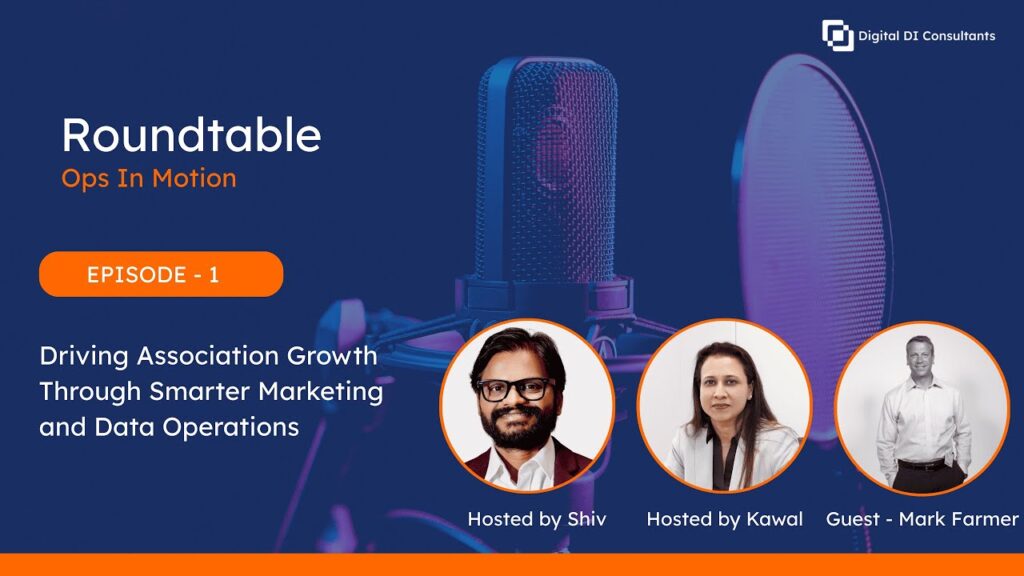
Episode 1
Transforming Marketing & Data Operations in Associations with Mark Farmer

Mark Farmer
He is a veteran consultant specializing in generating sustainable revenue sources for non-government related industry, professional, and trade associations. His role allows him to work both strategically at a high level and operationally on a daily basis, helping association clients succeed and grow.
Transforming Marketing & Data Operations in Associations with Mark Farmer
Introduction
Most associations aren’t failing at marketing. They’re failing at the database underneath it.
Mark Farmer is managing partner at Access Marketing and Events, where he works with trade and professional associations on revenue strategy. On this episode of Ops in Motion, he joined Shiv and Kawal to talk through what’s actually breaking association marketing today: stale CRM data, an ideal customer profile nobody’s touched in years, and technology stacks that got bigger without a plan.
Who should read this: association executives and marketing operations leads managing a CRM, ICP, or tech stack that hasn’t been reviewed recently.
Key takeaways
- A messy CRM database isn’t a data team problem. It shows up directly in revenue.
- ICP and TAM go stale fast. New buyer titles and market shifts appear quietly, and by the time you notice, the association has already missed them.
- Adding more martech without a plan creates the same silos it was supposed to fix.
- Marketing operations has shifted from sending emails and cleaning lists to owning the tech stack and reporting ROI straight to leadership.
- Listening to members and industry partners consistently is what keeps an ICP current. It’s not a one-time research project.
Your CRM database is quietly costing you growth
Associations tend to keep running the marketing playbook that’s worked for years. Shiv doesn’t take issue with that. His concern is the database behind it. Most associations haven’t kept it current with the same discipline they bring to campaigns and events.
Shiv put it plainly: a CRM used to just be a system of record. Today it needs to be something a team actively interprets, not just logs activity into. When that doesn’t happen, the effect isn’t abstract. It shows up in weaker campaign performance and, eventually, on the bottom line.
Mark’s firm treats data hygiene as a revenue function, not an IT task. Someone owns it. It gets reviewed on a schedule. It feeds directly into whatever program is built on top of it.
Shiv, co-founder of Digital DI Consultants and host of the episode, made the same point from the client side: a clean, current CRM database is fundamental to an association’s growth, and it’s still one of the things associations struggle with most.
Your ICP is already out of date, and you probably don’t know it
Mark walked through ICP and TAM as two connected ideas. ICP, the ideal customer profile, ranks your best-fit prospects and customers, similar to older recency-frequency-monetary scoring models. TAM sizes that same profile across regions and industries, which is what lets an association forecast market share and plan resourcing.
The mistake most associations make is treating ICP as something you build once. Mark’s example: as sustainability became a real corporate function, titles like “chief of sustainability” started showing up inside member companies. Associations that hadn’t refreshed their ICP recently missed those buyers entirely, not because they weren’t a fit, but because the title didn’t exist the last time anyone updated the model.
His method for keeping it current: give the ICP real time instead of building it in a single workshop, treat it as something you keep testing and enriching, push back whenever “we’ve always done it this way” comes up, and run a closed loop where new intelligence, human or AI-sourced, keeps feeding back into the model. Underneath all of it is one habit: listening consistently to what members and industry partners are dealing with, not running a survey once a year.
“The things that got you to where you are today aren’t going to get you to where you’re going tomorrow.”
— Mark Farmer
More technology isn’t making your marketing more strategic
Kawal, co-founder of Digital DI Consultants and the episode’s other host, has watched marketing operations shift from a support function into something closer to a strategic engine across association clients. She named five changes: segmenting and personalizing outreach based on real data, adopting automation to cut manual campaign work, owning the martech stack instead of just using it, building the ROI dashboards leadership actually asks for, and connecting departments like membership, education, and events around shared data.
Mark’s counterpoint is worth sitting next to that list. Associations are investing in more tools, HubSpot, Salesforce, Marketo, Tableau, expecting that investment to translate into better marketing operations. Often it does the opposite. A stack adopted piece by piece, without a roadmap, ends up with disconnected dashboards nobody fully understands.
The fix isn’t fewer tools. It’s ownership. When marketing operations owns and optimizes the stack instead of just logging into it, the silo problem Mark describes doesn’t happen in the first place.
“We’re seeing a lot of technology stacks out there that are not fully understood.”
— Mark Farmer
Action items
Assign one person or team to own CRM data hygiene. If it belongs to everyone, it belongs to no one.
Put a recurring date on the calendar to review your ICP and TAM. Don’t treat it as a one-time workshop.
Before buying new martech, map how it connects to what you already have.
Build your leadership dashboard around pipeline contribution and channel ROI, not vanity metrics.
Set up an ongoing listening process with members and executives to catch new buyer titles and market shifts early.
FAQs
How often should an association update its ICP?
There’s no fixed schedule, but it should be reviewed regularly rather than treated as finished. Watch for signals like new job titles or M&A activity inside your member industries as triggers to revisit it sooner.
Why does CRM data hygiene matter more for associations specifically?
Associations often run the same marketing approach for years without updating the database underneath it. That gap limits execution across sales, marketing, and membership programs, and it shows up directly in revenue.
What’s the most common mistake associations make with marketing technology?
Adding new tools without a plan for how they connect. It creates disconnected dashboards and data silos instead of solving them.
Talk to Digital DI Consultants
If your CRM or ICP hasn’t been reviewed in a while, that’s a marketing operations problem before it’s a technology problem. See how we approach CRM data operations and getting your ICP right, or talk to our team about your association’s setup.