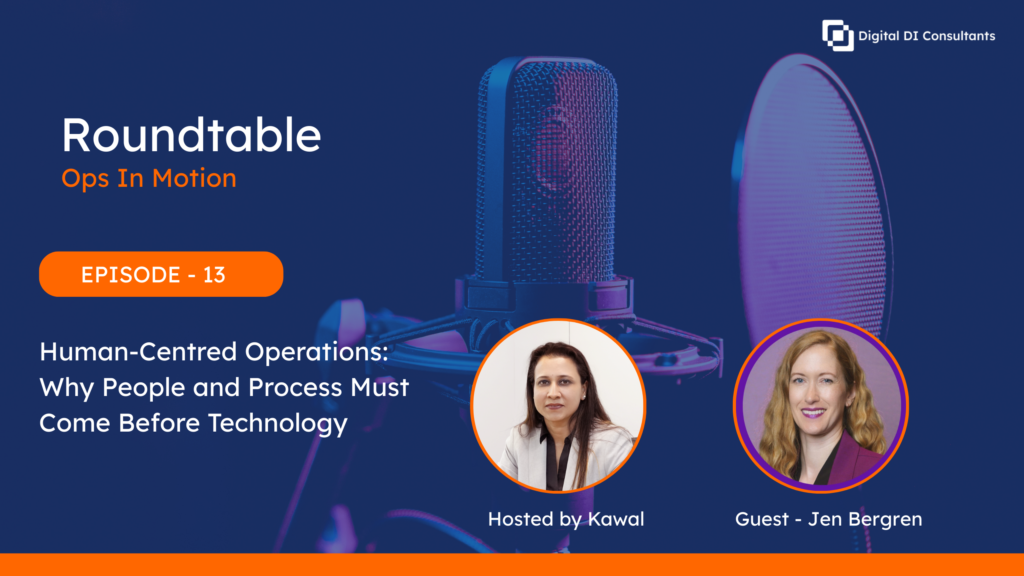
Episode 13
Human-Centred Ops: Why People & Process Come Before Tech with Jen Bergen

Jen Bergren
She has around two decades of B2B marketing and advertising experience. She designs education programs for companies focusing on learning, development, and enablement for marketers. She runs a weekly newsletter highlighting important topics in marketing and sales, and is an active member of the marketing operations community. She recently completed a master’s degree in instructional design and creates human-centered operations education programs including a free RevOps bootcamp focused on foundational skills like process mapping and project planning.
You’ve Probably Been Doing Operations Work Without Knowing the Word for It
Introduction
Jen Bergen spent her first career in print graphic design, her second running her own photography business, and eventually landed in marketing operations without ever setting out to. On this episode of Ops in Motion, she joined Kawal to explain how that happened, and why the common thread running through every job she’s had, however different they looked on the surface, was operations work she didn’t have a name for until years in.
Jen now designs education and enablement programs for marketing and operations professionals and writes a widely read newsletter covering what’s happening across the field.
Who should read this: marketing operations professionals early in their career, and leaders trying to understand why buying a new tool rarely fixes the problem they think it will.
Key takeaways
- Operations work often hides inside jobs that don’t carry the title. Recognizing it as a distinct skill set, not just “getting things done,” is often the first step toward building a real career in it.
- Buying software rarely solves a process problem on its own. People and process have to come before technology, not after.
- Rolling out a new system across regions or teams runs into the same resistance every time: people already have a way of working, and convincing them to change takes documentation and repeated conversation, not just training a new tool.
- Operations career paths are widening. VP of Operations, Chief of Staff, COO, and fractional roles are all becoming more common landing spots for people who started in tactical execution.
Operations work often hides inside a job that doesn’t call itself operations
Jen’s path looks scattered on paper: newspaper and magazine design, a retail company’s weekly coupon inserts, her own photography business, an MBA, then a HubSpot operations agency. Looking back, she can trace one thread running through all of it. The design jobs required managing fast-paced, high-volume deadlines, streamlining approval processes, and migrating between tools like Quark and InDesign. Running her own photography business meant building every process herself, since there was no one else to build it for her.
None of that work was labeled “operations” at the time. It was only once she joined a HubSpot agency and started using the word that she recognized what she’d actually been doing across every prior role. That recognition matters beyond her own story: a lot of people doing real operations work today don’t think of themselves as operations professionals, simply because their job title or industry doesn’t use the word.
“I realized that this is what I had been doing the whole time. I just didn’t know the word for it.”
— Jen Bergen
Buying the tool doesn’t fix the process
The theme running through the education content Jen builds is what she calls human-centered operations: putting people and process ahead of technology, rather than assuming a new platform will solve a problem on its own. Her point is a simple one that gets ignored constantly. Software rarely fixes a broken process by itself. If the underlying workflow, ownership, and communication aren’t sorted out first, a new tool just adds another layer to work around.
This is a useful lens for a common mistake: treating a tool purchase as the fix instead of the last step in a process that should have started with people and workflow.
Rolling out change across teams runs into the same resistance every time
Kawal’s experience running a global Marketo rollout is a concrete example of what human-centered operations looks like in practice. Every region had its own existing way of working, and convincing teams to adopt a new system wasn’t a training problem, it was a change management problem. Nobody was excited to give up a process they already understood for one imposed from a global team.
What actually moved the rollout forward wasn’t the tool itself. It was ongoing conversation with each region to understand their specific requirements, followed by documentation that established clear process ownership. That combination, listening first and documenting second, is what got adoption to actually stick.
Kawal’s later transition from in-house operations to co-founding her own agency reinforced the same lesson from a different angle. In-house, she was responsible for a defined set of processes. As a founder, she was suddenly responsible for strategy, execution, delivery, and client communication all at once, chaotic at first, but a forcing function for learning to own an entire operation end to end rather than one piece of it.
Operations career paths are widening well past the original job title
Asked where the field is headed, Jen’s view is that the fundamentals, communication, process design, alignment, aren’t changing. What’s changing is the pace, driven by technology, and the level of recognition operations roles are starting to receive. She’s seeing more senior titles emerge directly from operations backgrounds: VP of Operations, Chief of Staff, COO, and increasingly, consulting or fractional roles for people who’ve built deep operational expertise across multiple companies.
Kawal added a practical example of how fast the day-to-day keeps shifting even as the fundamentals hold steady: notifications that used to run entirely through email now happen instantly across platforms like Slack, which has measurably reduced response time but also multiplied the number of channels an operations person has to actively manage.
Action items
If your job doesn’t carry the word “operations” but involves managing process, tools, and cross-team coordination, recognize that as a transferable skill set worth naming on your resume and LinkedIn profile.
Before evaluating a new software purchase, map the process and ownership gaps it’s meant to solve. If those aren’t clear, the tool won’t fix them either.
When rolling out a new system or process across teams, budget real time for listening to each team’s existing workflow before asking them to adopt something new.
If you’re early in an operations career, look at senior paths beyond the obvious next step, VP of Operations, Chief of Staff, COO, and fractional consulting are all realistic long-term destinations.
FAQs
What does “human-centered operations” mean?
It’s the idea that people and process need to be sorted out before technology is introduced. Buying a new tool without fixing the underlying workflow or ownership rarely solves the actual problem.
Why do system rollouts across regions or teams often meet resistance?
Because teams already have an established way of working, and adopting something new isn’t just a training exercise, it’s a change management challenge. Listening to each team’s specific requirements and documenting clear ownership is what tends to get adoption to stick.
What career paths are available for someone in operations?
Beyond traditional operations titles, common paths include VP of Operations, Chief of Staff, COO, and consulting or fractional roles, especially for people who’ve built operational expertise across several companies or industries.
Talk to Digital DI Consultants
If you’re considering a fractional operations model or trying to figure out whether your process, not your tools, is the real bottleneck, talk to our team about your setup.