
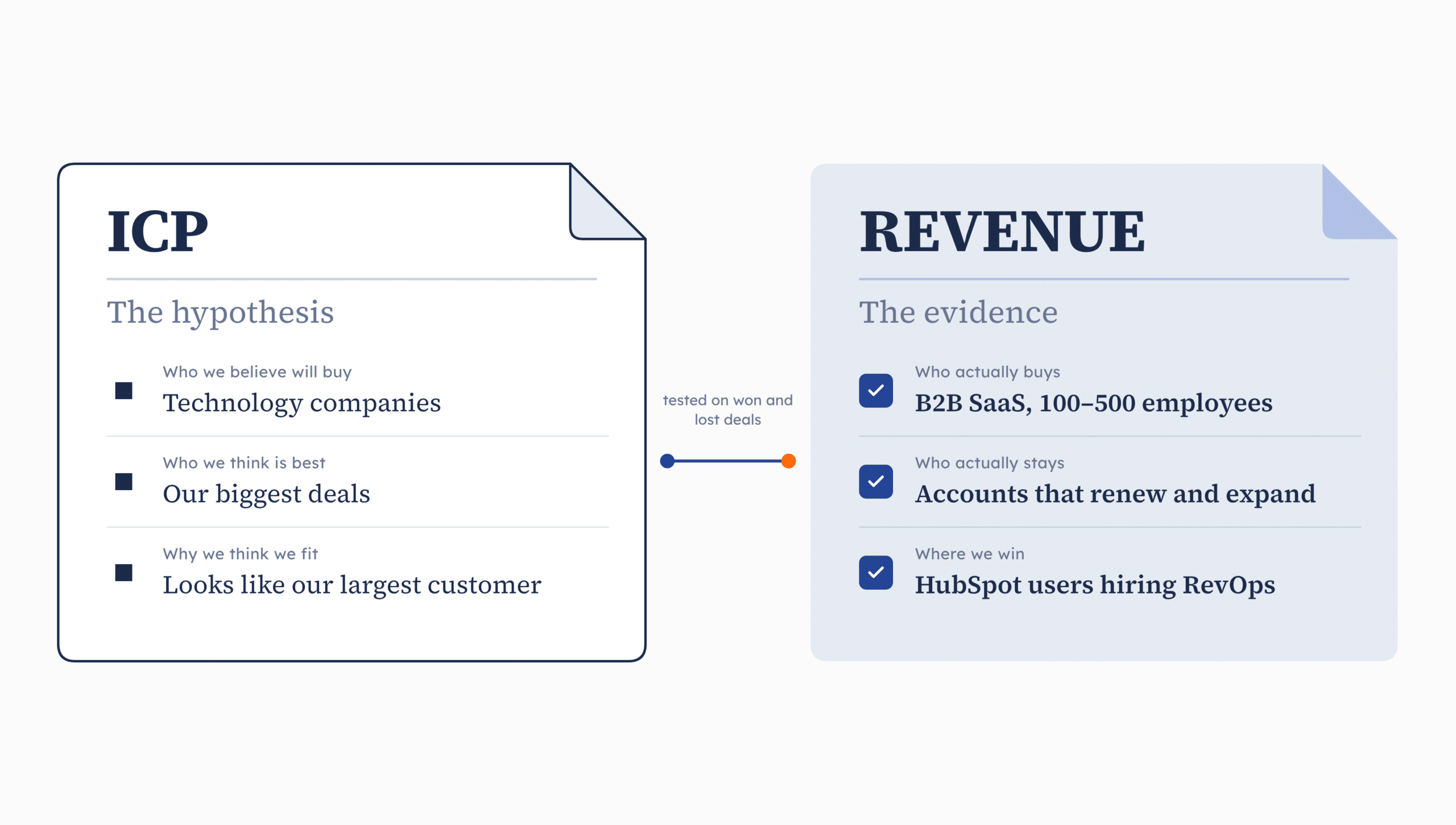
01What an ICP Actually Answers
If you ask five people in your organization to describe your ideal customer, and you'll likely to hear five different answers: an industry, a company size, a buyer persona, a use case, or perhaps a company that resembles your largest customer. Each perspective contains part of the truth, but none tells the full story.
An Ideal Customer Profile (ICP) is a clearly describes the accounts that are the best fit for your solution. It goes beyond identifying who is likely to buy. A strong ICP identifies the organizations most likely to buy, realize value, renew, and expand.
When sales and marketing are not aligned on what makes a qualified lead, the challenge isn't the leads themselves. It's the absence of a shared framework for qualification and handoff.
Without a documented ICP and a defined qualification criterion, every team creates its own definition of the ideal customer. The result is misalignment, inconsistent qualification, and revenue teams spending time pursuing prospects that are unlikely to become successful, long term customers.
ICP vs. buyer persona
These terms are often used interchangeably, but they answer different questions and should not be treated as the same thing.
| Dimension | ICP | Buyer Persona |
|---|---|---|
| Unit of analysis | The company | The person inside it |
| Question it answers | Which accounts should we target? | Who do we talk to, and how? |
| Data it's built from | Firmographic, technographic, behavioral | Role, priorities, objections, how they're measured |
| Built first | Yes, always | No, built inside a confirmed ICP |
| Lives in | CRM scoring fields, routing logic | Messaging docs, sequence copy |
Build buyer personas before you've clearly defined your ICP, and you risk creating highly targeted messaging for the wrong audience. That's one of the common reasons outbound campaigns underperform. The messaging may be well crafted, but if it's reaching the incorrect companies, it impacts response rates.
ICP vs. TAM
Your Total Addressable Market (TAM) is the total pool of companies that could buy your product. Your ICP is the subset of companies most likely to buy, realize value, and remain customers.
A TAM may include 40,000 companies, but only 1,500–2,000 may consistently convert, adopt your solution, and renew. Those companies make up your ICP. TAM defines the opportunity size. ICP defines where your team should focus.
B2B SaaS companies with 100–500 employees, using HubSpot or Salesforce, and actively investing in RevOps.
Within those accounts, you may engage multiple personas:
- VP Marketing — budget owner
- RevOps Manager — technical evaluator
- CEO — final decision-maker
The ICP identifies the right company. Personas help you engage the right people within it.
02Why Most ICPs Never Touch Revenue
Many companies have an ICP. Few of them use it. Research consistently shows that organizations with a clearly defined ICP achieve stronger win rates and more efficient growth. The problem isn't creating an ICP; it's operationalizing it.
Built on assumptions and not deals
Many ICPs are based on opinions rather than actual closed-won and closed-lost analysis. The best ICPs start with customer data, not brainstorming sessions.
Too focused on firmographics
Industry, company size, and revenue tell you what a company looks like, but they don't tell you if it will buy, implement, or stay. Strong ICPs also consider technology, buying behavior, and organizational readiness.
Built once, updated never
B2B contact and firmographic data decay fast; data is commonly estimated to decay by double digits each year, and sometimes more than 30%. An ICP created 18 months ago may no longer reflect the customers who are the best fit for your business today.
Never operationalized
One of the most common reasons ICPs fail to deliver results. The ICP is documented, presented, and approved, but never embedded into the day-to-day operating model. If it isn't reflected in CRM fields, lead scoring, routing rules, account prioritization, and pipeline reporting, it isn't influencing revenue. An ICP creates value when it guides decisions, not when it sits in a slide deck.
Most companies treat their ICP as a deliverable. High-performing teams treat it as infrastructure. If it doesn't exist inside your CRM in a way that can drive segmentation, scoring, routing, and reporting, it isn't operational yet, regardless of how good it looks on the slide.
03What Changes When the ICP Is Actually Right
B2B research suggests that companies with a documented, data-backed ICP tend to see higher win rates, lower CAC on ideal-fit accounts, and stronger retention. A well-defined ICP keeps Sales and Marketing aligned around the right customers instead of chasing a moving target.
This matters even more as B2B buying decisions grow more complex. Gartner reports that a typical buying group involves 6–10 decision-makers, each with different priorities. A vague ICP might get you a meeting, but it won't help you build a business case that wins over the entire buying committee.
Across B2B organizations, teams with a documented, data-backed ICP tend to outperform those relying on broad targeting. A well-defined ICP aligns Marketing, Sales, and RevOps, improving campaign focus, lead qualification, routing, and pipeline quality. A broad ICP may generate inquiries, but it won't consistently identify the accounts most likely to convert, expand, and retain.
A SaaS company refines its ICP from “500+ employees” to “SaaS firms with 200–1,000 employees, using HubSpot and rapidly hiring for RevOps roles.” The product stays the same, but targeting becomes more precise. CAC drops as marketing reduces spend on unlikely prospects, while win rates improve as sales stops pursuing poor-fit accounts that should have been disqualified early.
04Building the ICP From Closed-Won Data
Start with closed-won data
Start in your CRM, not a workshop. Export all closed-won deals from the past 12 months. If you have fewer than 50 deals, expand the window to 18–24 months.
For each deal, capture industry, company size, geography, funding stage, tech stack, trigger event, decision-maker titles, sales cycle, ACV, and 12-month retention status.
Analyze ACV and retention together. Your best customers aren't necessarily your biggest deals; they're the ones that deliver value and stay. Look for three to five attributes shared by 70–80% of your strongest accounts. These become your starting ICP criteria.
Common mistake: Sorting by deal size alone. A $120K deal that churns in month seven isn't an ideal customer. It's a warning sign.
Analyze closed-lost and churned accounts
Your closed-won data tells you who succeeds. Closed-lost and churn data help explain who doesn't. Both are essential to building a reliable ICP.
Look for recurring patterns: high support requirements, mismatched use cases, lengthy procurement cycles, or price sensitivity that never gets resolved. These patterns help define your disqualifiers.
If closed-won and closed-lost accounts look nearly identical based on firmographics, your model needs another layer. Add technographic and behavioral signals until you can distinguish good-fit accounts from poor-fit ones.
Add the four layers most ICPs skip
| Layer | What it captures | Example fields |
|---|---|---|
| Firmographics | Who the company is | Industry, headcount, revenue, geography, funding stage |
| Technographics | What the company uses | CRM, marketing automation platform, data stack, competitor tools |
| Behavioral signals | What's happening now | RevOps/MOps hiring, recent funding, leadership change, tech migration |
| Organizational readiness | Whether the company can buy | RevOps maturity, buying committee size, procurement process, evaluation timeline |
Firmographics help narrow the field. “B2B SaaS companies with 100–500 employees” is actionable; “technology companies” is too broad. The other three layers help distinguish between accounts that look similar on paper but have very different likelihoods of buying.
Define your negative ICP
Most teams document who they want to target. Fewer explicitly define who they should exclude. Your negative ICP should include industry exclusions, minimum company size, incompatible technologies, procurement red flags, and engagement patterns associated with deals that rarely close.
Better targeting doesn't always mean generating more leads. By excluding accounts that are unlikely to convert, you reduce wasted effort and give Sales more time to focus on opportunities with genuine potential.
Keep the ICP to one page
If your ICP needs several slides to explain, it's probably too complex for teams to use consistently.
“Our ideal customer is a B2B SaaS company with 150–500 employees and $15M–$75M ARR, headquartered in North America, using HubSpot or Salesforce, with a marketing team of at least five people. The company is actively hiring for demand generation or RevOps roles and struggling with pipeline attribution or lead quality. The economic buyer is typically the VP of Marketing or CRO. Average deal size: $X. Average sales cycle: X weeks.”
Negative ICP — accounts to exclude
- Fewer than 50 employees
- No CRM in place
- Non-SaaS business model
- Procurement cycles typically exceeding 12+ months
05Scoring: Turning the Profile into a Priority List
Defining your ICP is only the first step. Scoring accounts against it makes the profile actionable. Instead of relying on individual judgment, Sales and Marketing can use a consistent model to prioritize accounts and automate next steps.
Positive scoring
| Criterion | Weight | Example signal |
|---|---|---|
| Industry / vertical fit | +25 | Matches the vertical patterns to closed-won data |
| Company size (headcount + revenue) | +20 | 100–500 employees and $10M–$50M ARR |
| Tech stack compatibility | +20 | Uses HubSpot or Salesforce as CRM |
| Geography | +15 | Falls within your serviceable market |
| Behavioral / intent signal | +20 | Hiring for RevOps or recently raised funds |
Negative scoring
| Disqualifier | Points | Why it matters |
|---|---|---|
| Free or student email domain | −20 | Often indicates low commercial intent in B2B |
| Below minimum company size | −25 | Deal economics may not support acquisition costs |
| Tech stack incompatibility | −20 | Implementation complexity can undermine deal viability |
| Outside target geography | −15 | Creates coverage, compliance, or timezone challenges |
| No response after 90+ days of inactivity | −10 | Indicates a need to deprioritize the account |
Define your priority tiers
Route to Sales immediately, assign appropriate reps, and initiate personalized outreach the same day.
Add to active nurture and escalate when a meaningful buying signal appears.
Keep in low-touch nurture or disqualify based on your criteria.
One rule overrides the score: A demo request should always route to Sales immediately, regardless of fit score. Scoring helps prioritize accounts; it should never block a genuine buying signal.
Where to build this
HubSpot: Build and validate your model in a spreadsheet before configuring it in HubSpot. The legacy HubSpot Score property was retired on August 31, 2025, so teams should verify that their scoring setup uses the current tools. HubSpot's Lead Scoring tool supports separate fit and engagement scores, company-level scoring, decay, and thresholds, depending on subscription and configuration. Use flexible job-title matching so variations such as “VP of Sales,” “Vice President, Sales,” and “Head of Revenue” are evaluated consistently.
Salesforce: Use custom scoring fields or a dedicated scoring platform such as MadKudu to prioritize accounts based on your own closed-won and churn data.
Clay: Build enrichment workflows that combine firmographic, technographic, and behavioral signals. These workflows offer flexibility but require ongoing maintenance.
Apollo / ZoomInfo: Use their filtering and enrichment capabilities to build prospect lists that match your ICP. Start with a small validation exercise before committing to larger data or licensing investments.
06Getting Every Team Actually Using It
An ICP documented in a slide deck has little impact on revenue. An ICP embedded in your CRM, routing rules, and pipeline reporting becomes part of how your business operates.
Marketing
- Build ad audiences around ICP criteria, not your entire TAM. Focused targeting is more effective than spreading budget across broad audiences.
- Map content to specific ICP pain points. Broad industry content builds awareness; content that addresses your ideal customers' challenges helps move them toward a buying decision.
- Score every inbound lead automatically. Route high-fit leads to Sales immediately and move lower-fit leads into nurture instead of filling sales queues with poor-fit prospects.
Sales
- Prioritize Tier 1 accounts based on ICP fit, not territory or deal size alone.
- Use a three- to four-point qualification checklist covering company size, industry, and tech stack before the first outreach, not after two discovery calls.
- Focus discovery on the questions that predict deal quality, including business need, budget, and buying readiness. Disqualify early when the fundamentals don't align.
RevOps
- Map every ICP criterion to a filterable CRM field. “Mid-market” is too vague; “100–500 employees” is actionable.
- Maintain one shared account list across Sales and Marketing. Separate lists create separate targeting strategies, even when both teams claim to follow the same ICP.
- Track ICP match rates across the pipeline, not just lead volume. Three-times pipeline coverage means little if most accounts are poor fits.
- Layer behavioral signals onto static fit scores. A Tier 2 account that announces a funding round this week may deserve Tier 1 attention today.
Customer Success
- Use post-sale data, including product adoption, support volume, NPS, and expansion, to refine your ICP. It reveals which customers deliver long-term value, not just which ones are easy to close.
- Validate your ICP against renewals and expansions, not just new business. This is often where you uncover segments that convert quickly but churn just as quickly, the very accounts your negative ICP should help identify.
Ask your sales and marketing heads to independently list the 10 accounts they'd prioritize this quarter. If fewer than six accounts overlap, your ICP isn't fully operational. You may have one ICP on paper, but two different strategies in practice.
07When to Refresh It
An ICP is a hypothesis, not a fixed rule. Your product evolves, markets shift, and customer needs change. Your ICP should evolve with them.
When to revisit your ICP
- Rising churn: The latest customer cohort's churn rate is 3+ percentage points above the trailing 12-month average.
- Declining win rates: A segment that once performed well starts converting less often.
- Increasing CAC: Acquisition costs rise without a corresponding increase in deal size.
- Product changes: A new feature or product shifts which customers get the most value.
- Market expansion: You enter a new market or geography.
- Longer sales cycles: Sales cycles increase by 20% or more without a pricing change.
Establish a review cadence
Monitor ICP match rates in your pipeline reports. Investigate any 5% or greater decline and identify the segments driving it.
Review the previous 90 days of closed-won, closed-lost, and churn data. Check whether your criteria still distinguish high-performing accounts from poor-fit ones and adjust scoring weights when signals lose predictive value.
Reassess your ICP from the ground up. Is it aligned with where your business can grow today, or is it still based on the customers that drove growth in the past?
08Quick-Start Audit
Run this audit with RevOps, Marketing, and Sales in the same room. Any disagreement signals that teams may be working from different assumptions about the ideal customer.
Data foundation
- 12 months of closed-won data available in the CRM, with complete firmographic fields
- Churned and closed-lost accounts identified and included in the analysis
- Tech stack data captured for top accounts
- Behavioral signals, including hiring, funding, and technology changes, tracked for target accounts
ICP definition
- ICP built from closed-won data, not assumptions or a workshop alone
- All four layers defined — firmographic, technographic, behavioral, and organizational readiness
- Negative ICP documented with specific, filterable exclusion criteria
- ICP documented on a single page for easy reference and adoption
Operationalization
- Every ICP criterion is mapped to a filterable CRM field
- Scoring model built and validated against historical closed-won data
- Tier thresholds defined and connected to routing workflows
- Sales and Marketing working from one shared account list
- ICP match rate included in regular pipeline reporting
Ongoing maintenance
- Quarterly cross-functional ICP review scheduled
- Win rate and churn tracked by customer segment, not just overall
- ICP refresh triggers monitored monthly
09Frequently Asked Questions
How long does it take to build a real ICP?
We can develop a first version in a focused half-day workshop, using clean CRM data and input from Sales, Marketing, and Customer Success. Data extraction and enrichment typically take 2–5 days, depending on CRM quality. Operationalizing the ICP through scoring, routing, and CRM fields usually takes another 2–4 weeks for mid-market teams.
Should we have multiple ICPs?
Some companies need two or three ICPs for distinct product lines or customer segments. Each adds operational complexity, including separate scoring models, content, and reporting. Start with one primary ICP and introduce additional versions only when closed-won data reveals distinct, profitable segments that the primary ICP doesn't capture.
We're early stage. Do we even need one yet?
If you have fewer than 30 customers, a rigid firmographic ICP may limit learning before you've established product-market fit. Focus first on why customers buy, the problems they need to solve, and the value they get. As your customer base grows and repeatable patterns emerge, introduce more specific firmographic and technographic criteria.
How do we get Sales and Marketing to use the ICP?
Embed it into the tools teams already use: CRM fields, scoring workflows, routing rules, and pipeline dashboards. Make ICP match rate a standing item in monthly pipeline reviews. When leaders consistently use ICP criteria in deal reviews and prioritization, the ICP becomes part of how teams operate, not another document they're expected to remember.
What's the difference between ICP fit scoring and lead scoring?
ICP fit scoring evaluates the account: its industry, size, technology, and organizational readiness. Lead scoring measures an individual's engagement through signals such as pricing page visits, email interactions, and webinar attendance.
The two work together. Fit indicates whether an account is worth pursuing; engagement helps determine when to act. A high-fit account with little engagement may still be worth nurturing, while a highly engaged prospect at a poor-fit account may not justify significant sales effort.
Not Sure Your ICP Is Actually Driving Pipeline?
Digital DI Consultants helps scaling B2B teams define, score, and operationalize their ICP within a connected GTM Operations framework, aligning CRM data quality, lead management, marketing automation, and RevOps.
Talk to Our Team →